

The upshot of the whole heat exchanger exercise, I realize now (with chagrin) was that the heat exchanger unit wasn’t really broken at all. Three weeks of working on it and nearly a thousand dollars in parts later (don’t get me started on that account), I have come to the realization that this was a classic case of attribution error: Yes, the coolant level was going down every time we sailed, and yes, the hot water heater wasn’t heating water for the boat after a long session of motoring. But after tearing into the systems in the back of the boat over a period of three weeks, I discovered that 1) the hose connecting the engine to the hot water heater had come off, so no water was going into the hot water heater, resulting in (you guessed it) no hot water. Secondly, since I had the opportunity to become intimately familiar with the heat exchanger tank and element over the course of tearing it down three separate times, and getting a better understanding of the way the impeller forces water through it, it dawned on me that replacing the heat exchanger element didn’t improve the situation of the coolant dropping every time the engine was run. The thing just seems to lose water to the level of the lowest point of the heat exchanger element when the engine runs. Keeping a close eye on the thermostat, however, shows the engine staying right at 140 degrees, even on long motors of an hour or more. I’d be open to hearing from anyone who has experienced a similar situation with their Perkins Perama M20.
Fair winds and smooth sailing. DB

Update October 2022: Oh, FFS! The solution was staring me right in the face all along.
For those just tuning in, the backstory is this: When I first bought this sailboat, the guy I bought if from said, “Oh, by the way, you have to add a little water (a pint or more) to the radiator every time you start up the engine.” So, since October 2010, that’s what I did. Apart from being a pain in the behind, though, I alway had this nagging feeling that something wasn’t quite right about that. But it seemed to work, and I was intent on sailing, so the years rolled by.
But that nagging feeling never quite went away. So diving back into this fall, and after doing some research (actually reading the frickin’ Perkins M20 user’s manual thoroughly for once!) I thought the real problem with the missing coolant might have something to do with not having coolant in the reservoir underneath the galley sink (a related part of the solution, as it turns out), but there’s more to the story.
I also thought, after reading up and studying the “caps” on the end of the pipe stack, that the assembly might be missing O-rings on each end (are there supposed to be O-rings?, I thought), to better seal the caps to the tube stack. I was getting closer.
My new best friend and role model Ancil (the fellow sailor who lets me keep my boat in his pasture in the winters and a very mechanically inclined guy) came aboard as I was winterizing Splendido the other day, and I told him what I was up to, and then he said, “let me take a look at the engine.” I had already opened everything up, so I invited him into the cabin and he started examining the engine front and back.
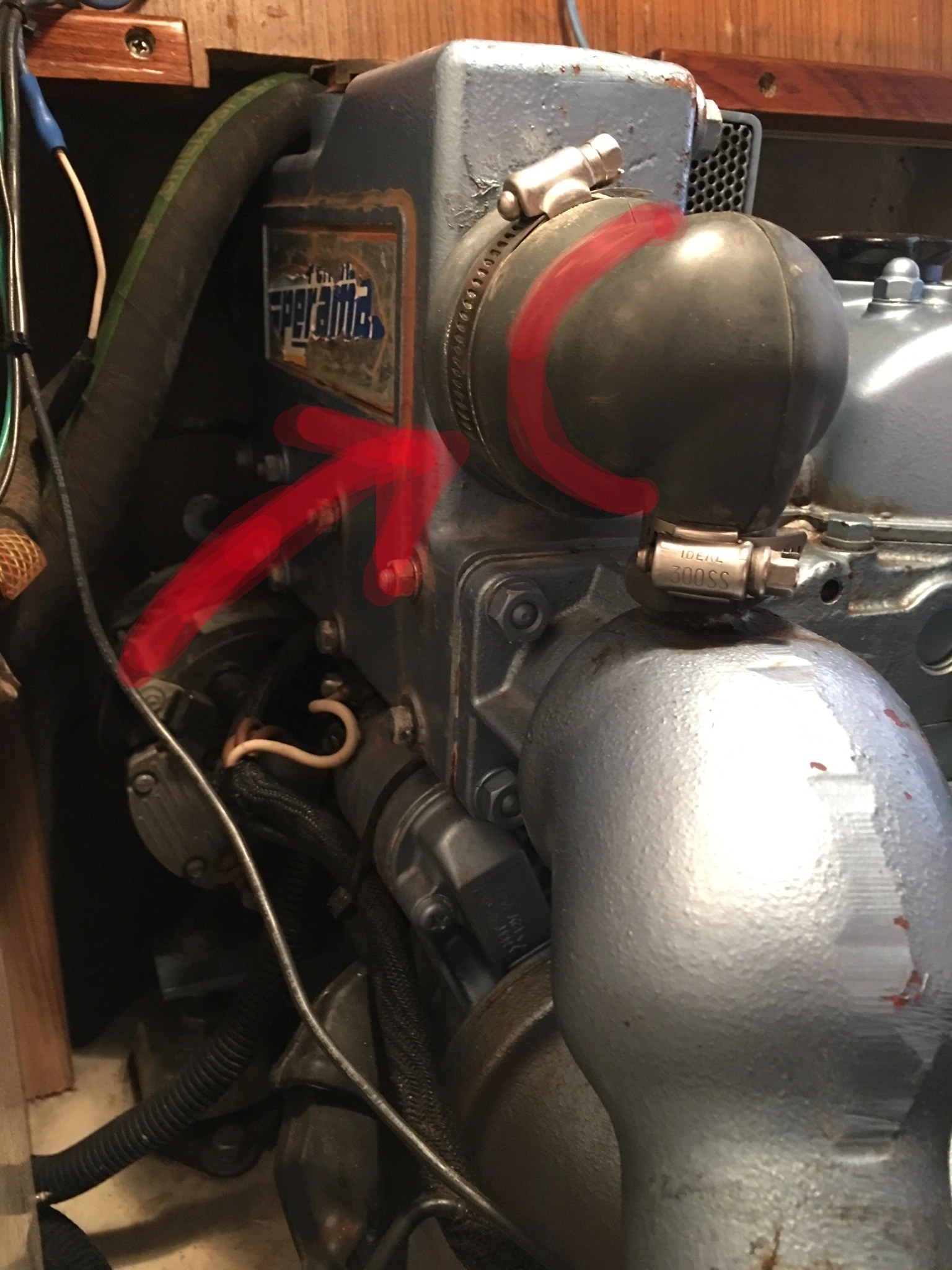
It Was Missing a $2 Hose Clamp on the Exhaust Side, Dagnabit!
At length, Ancil noticed something I hadn’t noticed in all the years I’ve owned the boat: the “cap” leading to the exhaust only had one (1) stainless-steel hose clamp instead of the requisite two (2) hose clamps — the missing hose clamp was the one that encircles the tube stack itself — so this oversight was allowing the cooling lake water and the radiator coolant water to blow right out the exhaust. (Fortunately, since we only sail four months in the summer, I have only been using tap water as coolant all these years because I didn’t want any antifreeze going in the lake. I just drained all the water out of the engine’s water course when winterizing every fall.)
Ancil tossed me a $2 hose clamp and suggested I get a wire brush (and maybe some steel wool) to brush away the corrosion on the male ends of the heat exchanger housing where the caps connect, and also using some dielectric grease applied to the rubber caps to help in sealing those to the heat exchanger. Then, tighten tighten tighten the hose clamps (all four, in this case) — especially the one exiting the tube stack, and that should fix things.
So, that’s what I did. Then, I topped off the tank with real 50/50 mix coolant (after gently hammering the rim where the radiator cap sits into perfect flatness, as it looked a little high on the front end), attached the fake-a-lake hose to the seawater intake thru-hull, and fired up the Perkins Perama diese engine. I let it run for about 30 minutes to get it up to temperature, then went full throttle for about 4-5 minutes on Ancil’s advice, to blow out the carbon that had built up in the engine. After shutting it down, I came back the next day and opened up the radiator cap, and voila: the coolant was filled right to the rim. For. The. First. Time. Since. I’ve. Owned. The. Boat.
Yes, folks, the Mystery of the Missing Coolant is finally — and somewhat embarassingly — solved.
Addendum: Filling the Undersink Coolant Reservoir
I should note that, before Ancil showed up, I filled up the coolant reservoir (no easy task — for starters, it’s incredibly hard to reach, as it sits on the aft wall underneath the galley sink, and it is quite high up. Access is through the cupboard door below the sink, so it took some serious contortions to get coolant into it. I started putting it in cup by cup, but then took a stab at slithering the 1-gallon jug throught the hoses and gently angling it toward the top opening. My back was beginning to ache, as was my core, so I grabbed the life sling bag and used that to cushion my backside. Ever so slowly, I was able to get the jug’s mouth over the reservoir opening and fill it about 2/3 of the way up. (Hint for next time: Use a sports bottle or get a shallow funnel to catch the spills.)
Happy to Take One For the Team
A lot of folks wouldn’t even admit to making such a bone-headed mistake as this one with the missing hose clamp, but if it helps even one sailor out there fix a similar problem, then I’ll take the hit and be happy that someone else doesn’t have to go through the same hassle as we did. Occam’s razor, folks: The simplest solution to a problem is the most likely solution. Painful lesson learned.
Fair winds and smooth sailing. DB
 Sailing Lake Tahoe on a good old boat
Temperature gauge. I replace my temperature gauge and it stays pegged at over temp. My guess is that it is the sensor mounted on the block. Have you installed an over temp alarm? Bought one and a low oil pressure alarm but can’t determine where to install those sensors. On a Catalina 270 the gauges are down at my feet and hard to see.
LikeLike
Have a look at the latest Sail Life video about the sensors added to a D series Volvo Penta diesel inboard. If you look at the Sail Life web page he gives all the details on where he go the sensors. The temperature one I guess goes onto the coolant hose at some point I would say after the heat exchanger. It’s worth looking at the video even if he does rush it a bit .
On Sun 13 Mar 2022 at 3:45 p.m., Sailing Lake Tahoe on a good old boat wrote:
> Jim Oursler commented: “Temperature gauge. I replace my temperature gauge > and it stays pegged at over temp. My guess is that it is the sensor mounted > on the block. Have you installed an over temp alarm? Bought one and a low > oil pressure alarm but can’t determine where ” >
LikeLike
Did you continue to lose coolant ?
What was the solution?
LikeLike
I’m not sure as I’m still on the hard , and I expect I will unless I change something. I must switch exhaust elbows, and that is in progress. I hope it’s not the head gasket ? !!!
Regards
John
On Sun 13 Mar 2022 at 3:34 p.m., Sailing Lake Tahoe on a good old boat wrote:
> Jim Oursler commented: “Did you continue to lose coolant ? What was the > solution?” >
LikeLike
Hi, I too have a Perama M20 and I am losing coolant now every time the engine is run for an hour or so. Have not taken off the HE.
Did you get to work out what was happening with your engine ?
Thank you
LikeLike
Hi, and thanks for reaching out! I don’t have a definitive answer, but what I can tell you is that we replaced our thermostat and now everything seems right as rain. I think I had a fundamental misunderstanding of what was happening in these engines as far as cooling goes. What we do now is top off the coolant tank with fresh water every time at the beginning of a sail, and this “primes” the seawater/lakewater cooling water to run through the engine. With the new thermostat, it comes up to temperature and if it gets too hot, the thermostat opens and you see the temp gauge immediately drop to ~140º F. So that tells me the thermostat’s working fine. I think what happens after turning off the engine is that the water topsides of the thermostat evaporates a bit, so it appears low the next time we come out and sail. But I just make a point of topping it off with fresh water each time when I go back to open the raw-water seacock and check the oil prior to starting the engine. So far, so good, and fingers crossed.
LikeLike
hello having that problem of losing coolant …is your motor still running with low level of coolant thanks i have a perkins perama 30 Luke from B.C.
LikeLike
The coolant thing is still a bit of a mystery to me … what I assume is happening is that it just needs topping off with water every time I sail because the heat exchanger part just lets so much drain out. I am going to look into it more this season, and I’ll post what I find out. Thanks! DB
LikeLike
DB:
Thanks for the story. We have Catalina 270 hull 170 which we bought in 1995. We are replacing the corroded (saltwater) exhaust elbow on our Perkins Perama M20, and we find the heat exchanger also needs replacement. Do you still have your original, didn’t actually need replacement, heat exchanger? If so would you like to sell it? My condolences on trying to work in the “engine room” on a C270. I have often, and recently, thought that designers of devices nearly impossible to service should be sentenced to doing repair work on their creations, again, and again, and again …
LikeLike