

 As you may have guessed, I am an eager student when it comes to all things sailing. So, if I’m not sure about how something works, I’ll find somebody with more expertise than I do who I can ask for advice. On May 24th, sailor Marc Sykes joined me and my brother-in-law, Tracy, on board Splendido to check on how Tracy and I had initially rigged her. Marc is an accomplished sailor who owns a J-35 in the Bay Area, and who frequently races to places like the Farallone Islands and Monterey, often single-handed. A former U.S. Coast Guard man, Marc has sailed on Splendido since she was new, so he has known the boat “man and boy,” as Master & Commander novelist Patrick O’Brian would put it.
I had only met Marc briefly after I had purchased Splendido last fall. He had come up to Tahoe City to help with the de-commissioning, and I quickly saw why friends call him the “Real Sailor.” He certainly knows his way around sailboats, among many other things. I jumped at the opportunity to have him check over our work. Here’s what we learned in three hours of hands-on work and discussion:
The In-Column Mast We did a pretty good job of stepping the mast on Splendido, despite sort of winging it. We were within 1/2 inch of vertical side-to-side. Marc showed us how to measure mast alignment athwartships by using the main halyard. Touch it to the water fill-port cover and take up the slack, then lock the cleat. Walk the halyard around (outside the shrouds) to the holding tank port cover, and measure again. This will show how straight the mast is. The halyard should touch each cover, and let you quickly see how much adjustment is needed.
Forestay/Backstay Forestay and backstay tension is established through the backstays. On our 18-year old Catalina 270, they are pretty cranked down.
Shroud Tension Use the Loos® gauge to measure the relative tension on each set of shrouds, comparing port and starboard measurements. We balanced each set, then wrote down the measurements (15 – 16 seems to be the range).
Turnbuckle Security Rather than use stainless-steel cotter rings, Marc recommends UV-protected, exterior-grade zip-ties (the very small ones)to secure the turnbuckles on both the standing rigging and the lifelines. At the end of the season, it’s just a matter of snipping the zip-ties at de-commissioning time.
Fairleads For our smaller #3 jib, position the fairlead blocks up to the fourth or fifth hole from the bow end. For our larger jib, we’ll move the fairlead blocks to the second or third hole from the stern end.
Mainsheet Position the mainsheet angled back just like the boom vang for more vang-like control of the boom.
Traveler This is used to control twist in the sail in windier conditions. Marc says to play with it to sense its effect on sail trim. (He also said he’d sail with us to demonstrate.) My sense so far is to move it to windward to increase twist and spill off excess wind at the top of the sail when the wind comes up.
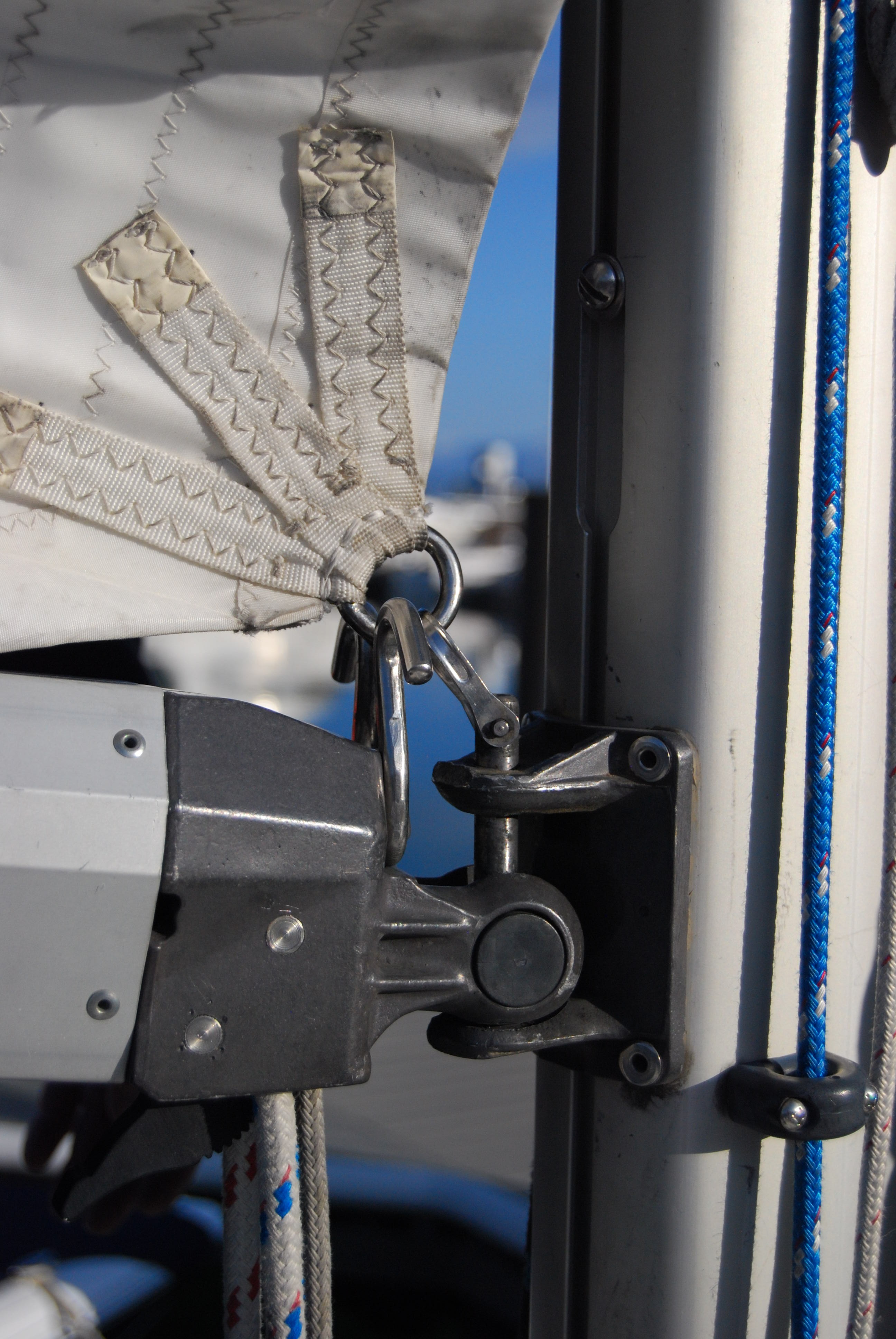
What We Screwed Up On When I was attaching the boom to the mast at the gooseneck, I had put the pin in upside down (I inserted it from the top. It should insert from the bottom.) The shackle at the top is what the mainsail attaches to. (I had the mainsail hooked to one of the reefing hooks!) Marc got a good chuckle out of this. Here’s how the gooseneck on the Catalina 270 should look when assembled.
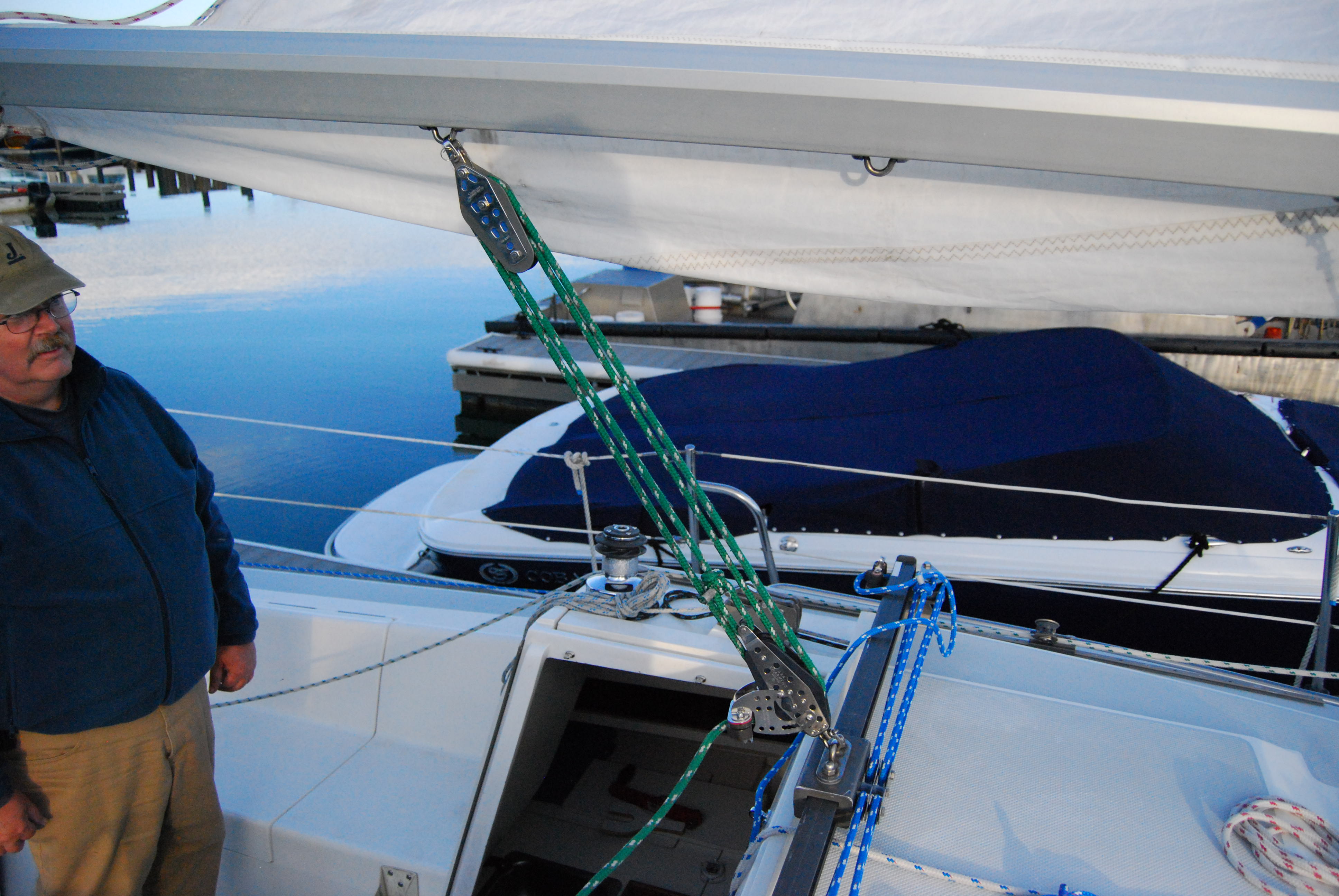
The next screw-up was accomplished with the help of another friendly sailor, who offered advice from dockside while we were putting on the boom vang. (We ultimately installed it upside down. You can see it incorrectly installed in the top photo, behind Marc). Here’s how the boom vang on the Catalina 270 should appear when it’s assembled correctly.
Our next screw-up was straight out of the Catalina Owner’s Manual. We were “painting by numbers” and reading the manual with its hand-drawn pictures, and we ended up with the mainsheet too vertical. Marc advocates raking it back so it has more boom vang-type action, so we angled it back. Here’s how the mainsheet on the Catalina 270 looks when properly assembled.
Reefs This was another of my screw-ups, but I forgot to take photos. Anyway, on the Catalina 270, the reef lines are rigged red to port and blue to starboard. The lines go through the holes on their respective sides, and tie off at the boom with a simple figure-eight knot through the D-ring under the boom. When reefing, loosen the main halyard, hook on either the first or second reef point with the upside-down “W” shaped hooks at the boom gooseneck, and then tug on the red or blue reefing line to bring the clew-end down to the boom. To shake a reef, reverse this process. The reefing ropes in the sail should be ½ & ½ on each side of the sail. Use a simple overhand knot to secure those lines in place.
Main Halyard On the Catalina 270, Marc recommends that, when not in use, the main halyard should be clipped to the D-ring by the stern pulpit (near where our LifeSling® is located).
Backstay & Boom End When securing the boat, wrap a bungee cord around the split backstays and the topping lift, to keep the boom from swinging if the wind comes up.
Coiling The Lines Marc recommends using a figure-eight motion (this prevents twist in the ropes), then proceeding with a twist at the top, wrapping the standing end around several times and then “through, over, and around,” pulling it tight at the end. This makes a great-looking, twist-free coil.
Flaking The Sail Hoist the sail all the way up, then have the person by the mast use one foot as a “brake” on the main halyard as it runs through the block at the mast base to slowly let the sail down. Make folds of even length, letting the alignment of the “cars” or “slugs” indicate the folds. The battens should always fall on top of the boom. After three or four folds, tie a sail-tie on, then keep up the same technique as you move toward the mast. The sail should flake beautifully every time. Then, put on the sail cover and tuck the lines in for a tidy boom.
Other Important Things We Learned
Get Captive-Pin Shackles All those small pieces get squirrely when the boat’s rocking and rolling, so consider replacing older shackles with captive-pin models.
Our Weird Plumbing Is OK Marc thinks the “pull the water from the lake” T-fitting at the engine-cooling water thru-hull (for unlimited water for the sinks and showers) is fine, as long as it doesn’t leak. (Just double-hose clamp everything and shut off the thru-hull normally when not in use.)
The Paint Is Hard Pettit Trinidad is a hard paint, not ablative like I first thought.
Keep The Boat Flat A flat boat is a fast boat: too much heel is slow—and uncomfortable. Reef early if weather threatens. Consider getting the books “Sail Trim” and “More Sail Trim.”
Rebuild The Winches Every Season Harken has a great video, and Marc said he’d help if I ask him.
Our Sails Are Old Consider replacing Splendido’s sails with newer ones as budget allows, and consider getting a UV sleeve for the furling jibs, to protect from sun exposure at 6,229 feet above sea level.
It was an outstanding afternoon of learning on board Splendido with Marc Sykes, and many thanks to him for his friendship and expertise. Splendido is now fine-tuned to sail, and we can’t wait to get out on her once the weather improves.
Fair winds and smooth sailing! DB
 Sailing Lake Tahoe on a good old boat
I keep forgetting to post this and finally remembered…the Loos gauge measurements that seem to work for Splendido, our ’93 270, is 15 to 15.5 on all the shrouds. On the backstay, I just crank it all the way. Seems to work OK. Thanks!
LikeLike
Just purchased a 1993 270 and I curious what your rigging loos gauge tensions are. My shrouds seem too loose on the leeward side in moderate wind.
thanks,
mike
LikeLike
Hi, Mike! I’ll have to look up the Loos Gauge numbers. Where do you sail your 270?
LikeLike