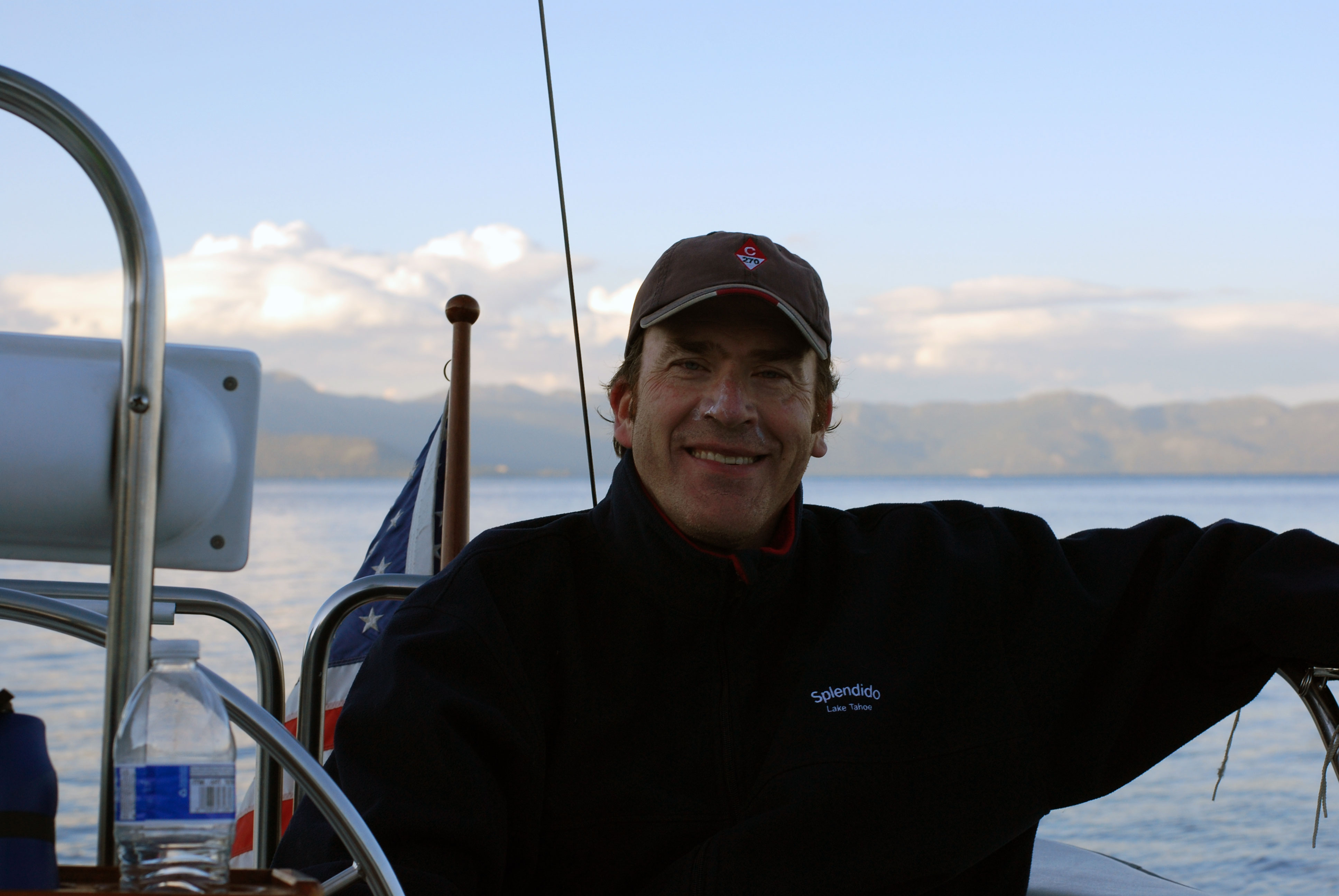
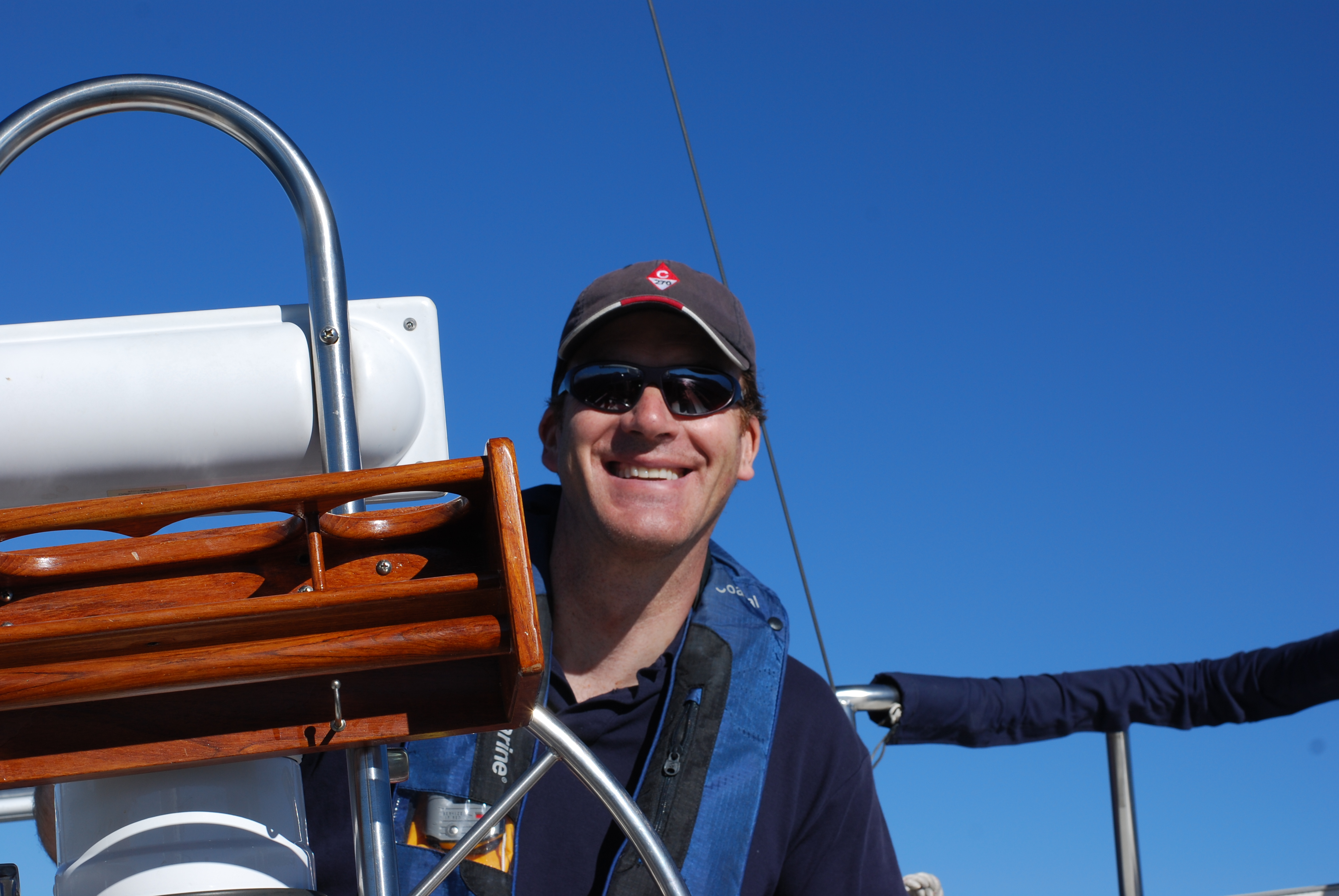
It has long been my ambition to do a complete circuit around Lake Tahoe; to get a sense of the lake in its entirety, to explore her moods, to check out her interesting coves and bays and stretches of coastline that I don’t usually have the time to look into as primarily a day-sailor (and at best, a single-overnighter) on this lovely sheet of blue water stretched out at 6230’ high in the Sierra Nevada. This past summer, I took a week off to do my first “circumnavigation” boat-camping trip on Lake Tahoe, along with my good friend, Jamie Filbin.
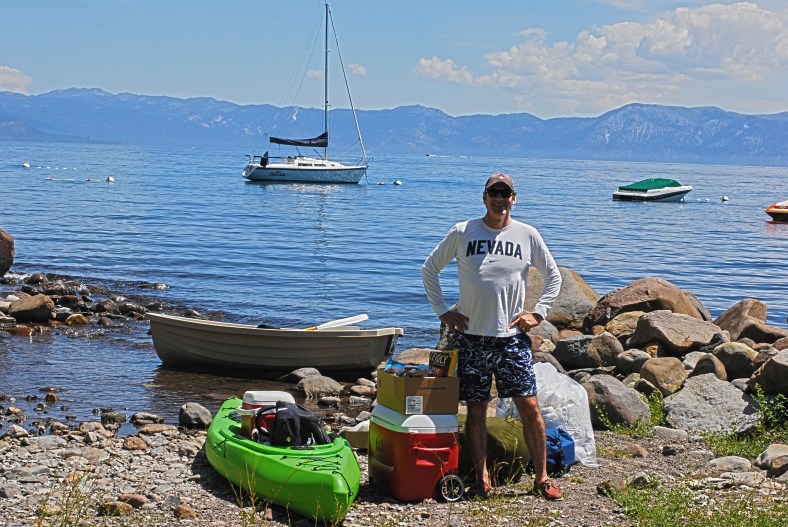
Day One – Home Buoy at Skyland on the West Shore
Lat 39º 06’ 49” N
Lon 120º 09’ 22” W
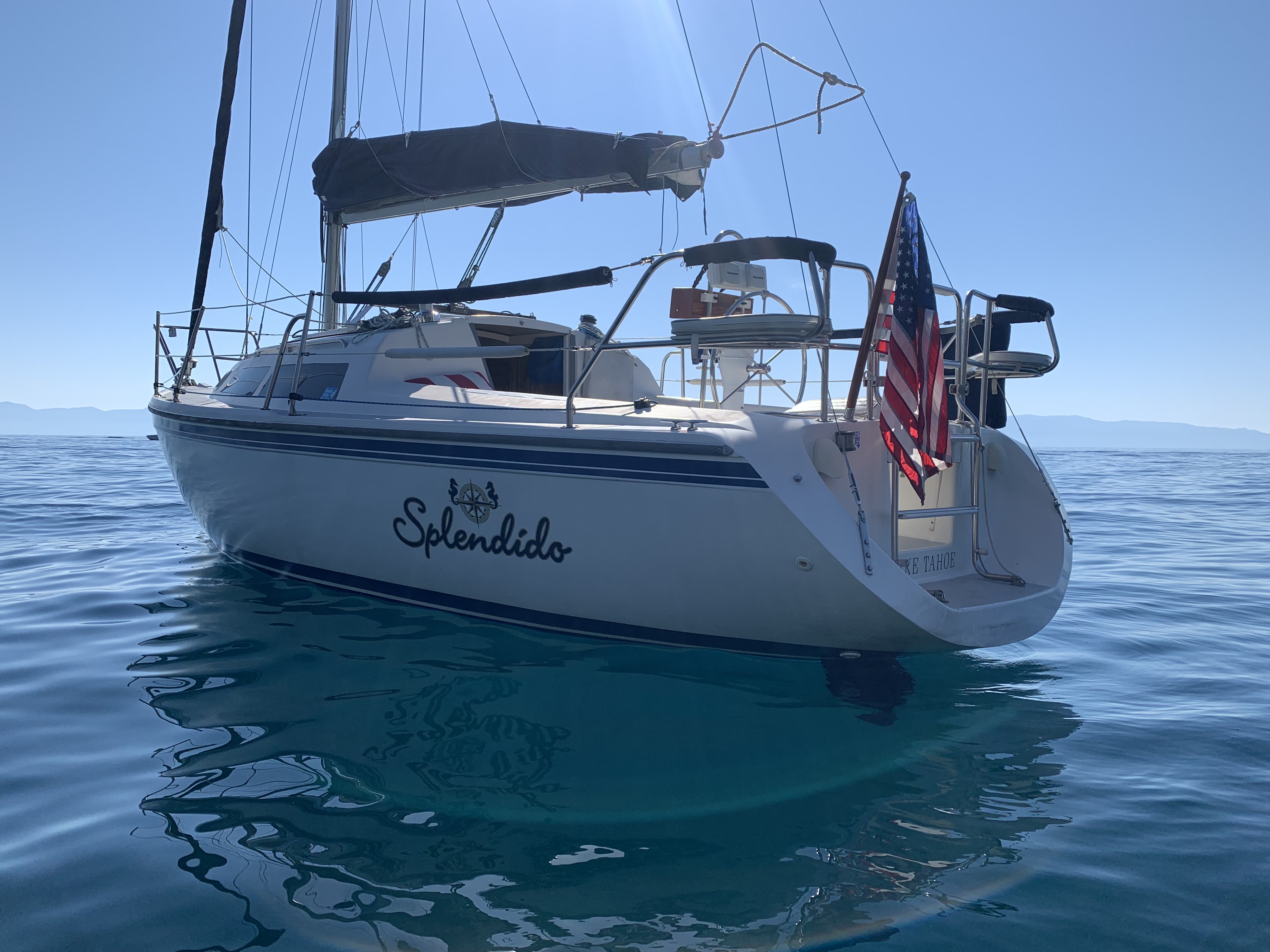
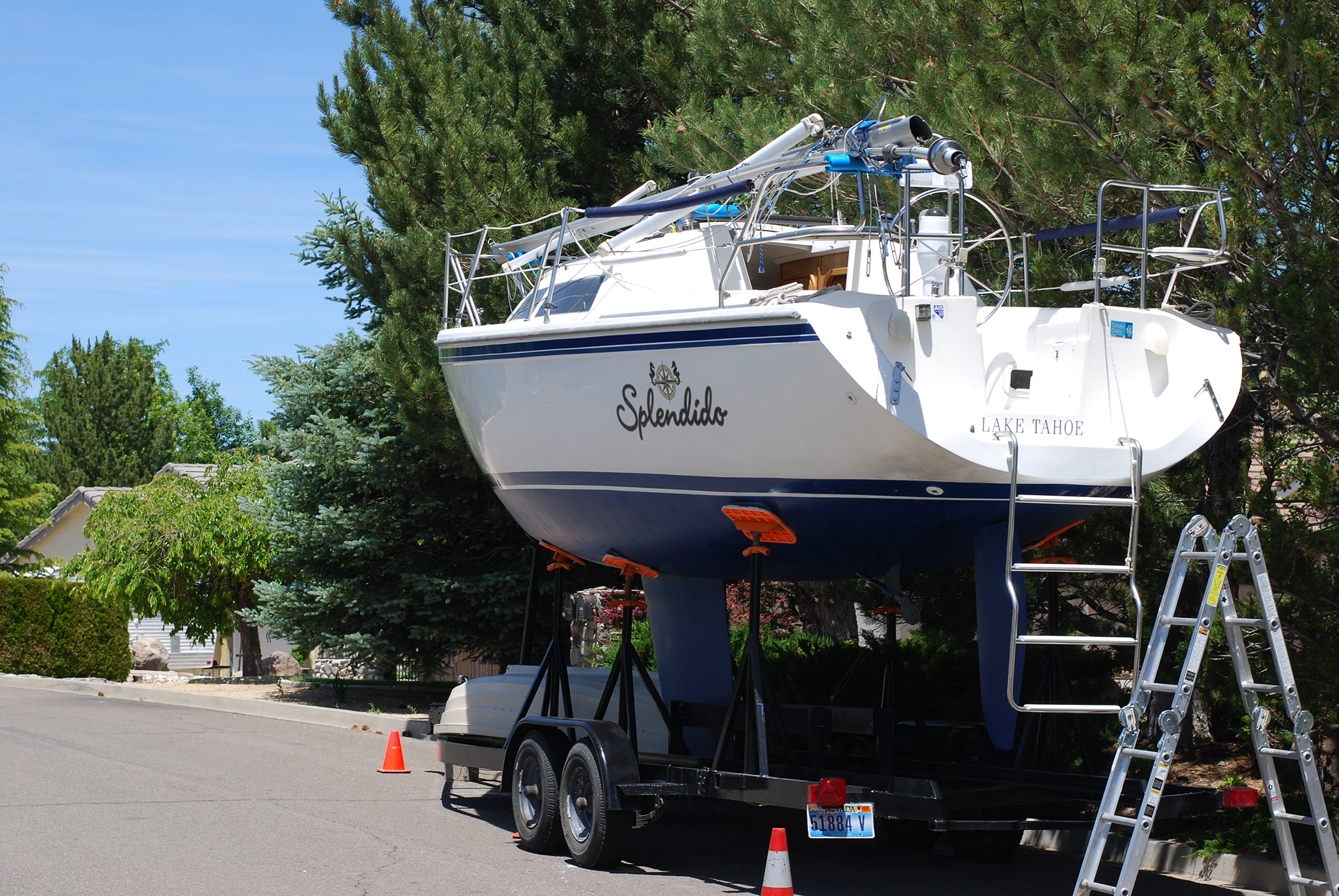
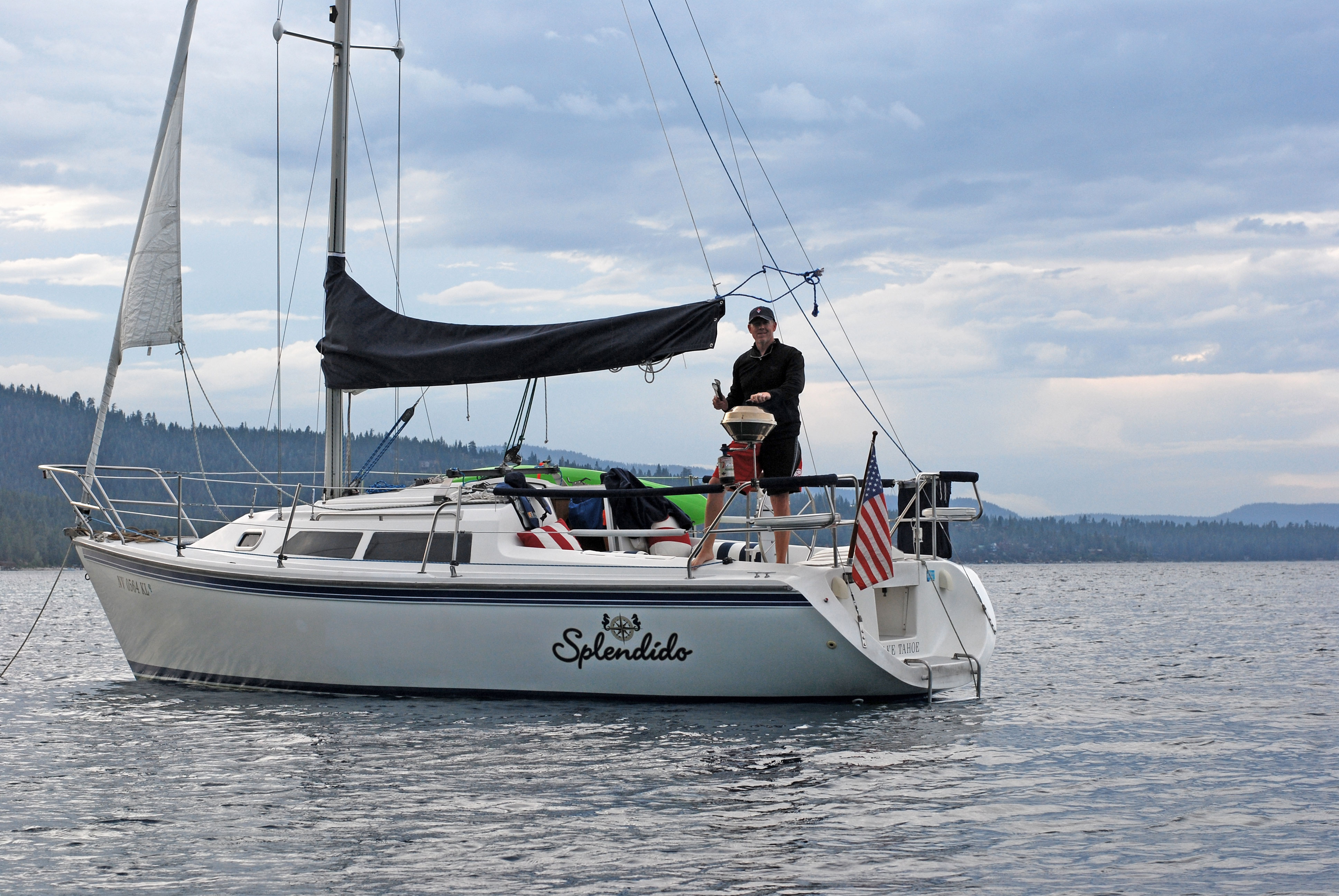
Jamie and I arrived at the boat about 11:30 a.m. on Monday, July 20th with all of our gear for a week aboard Splendido. Debbie gave me a stern look with the admonition not to make Splendido a “bachelor boat,” so we carefully stowed everything nicely, and I think Debbie would have been quite impressed at how well we hid all the gear and made a pretty balanced boat.
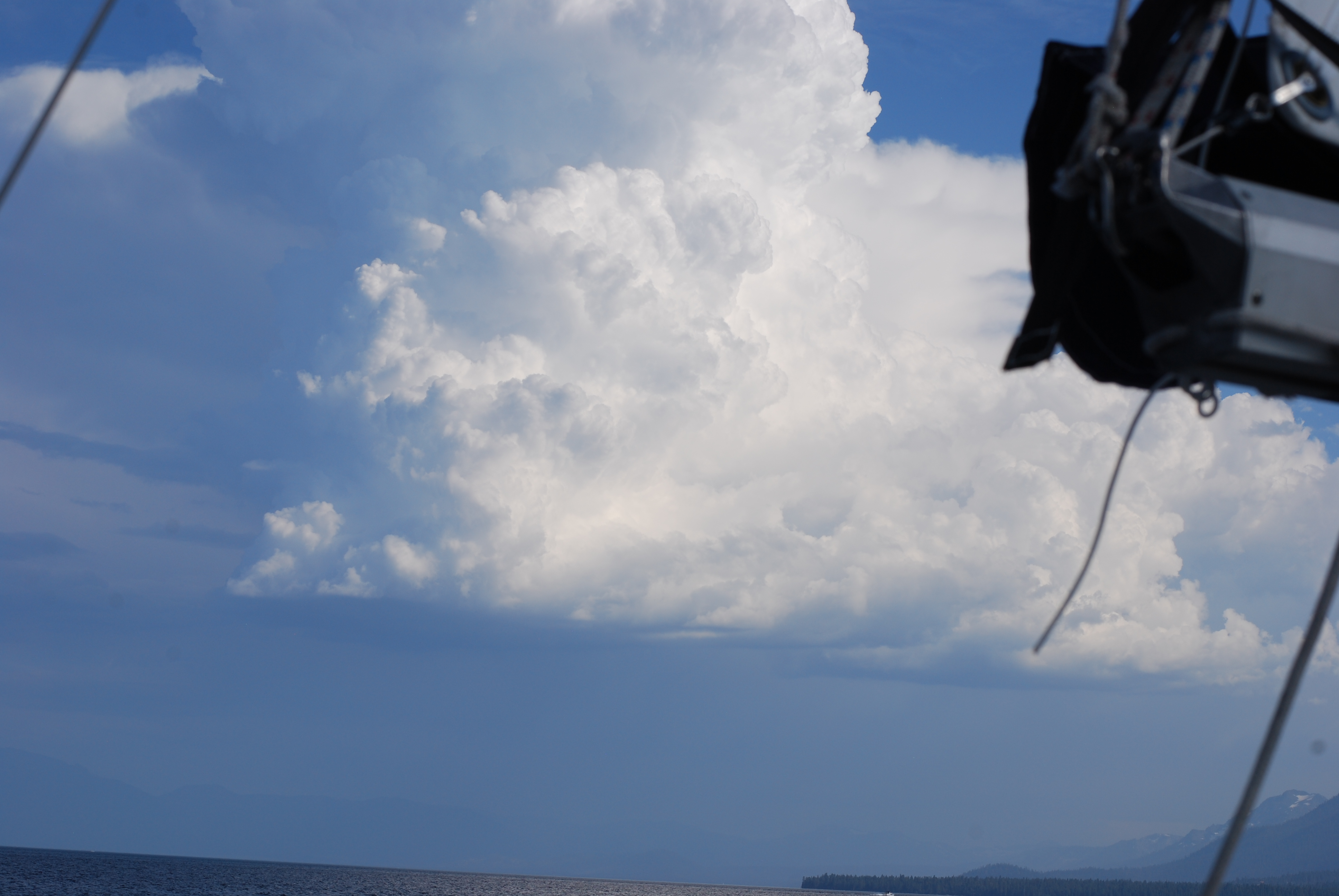
After getting everything ship shape, I went through my checklist and went to fire up the engine. Nothing happened. In our haste to get off the boat the previous Thursday, I forgot to turn off the master switch and left some lights on, and evidently we drained the batteries. So, we offloaded the batteries into the dinghy, drove down to Obexer’s for a trickle charge, and went for a swim while waiting for the batteries to recharge. Jamie was great, telling me not to beat myself up about it, but I was watching the anvil clouds mass over the mountains and thinking about making the run down to D.L. Bliss State Park.
As it turned out, the worry was for nought. We got both batteries up to 75% in about an hour, and the Perkins Perama fired right up. We motored at 4.6 knots toward Sugar Pine, and a bit of a breeze came up, so we put out 1/3 of the jib and it pulled us up to 5.5 to 6 knots. Once past Sugar Pine, Meeks and Rubicon Bay had a bit more wind, so we continued on and were hitting 6.5 knots as D.L. Bliss hove into view.
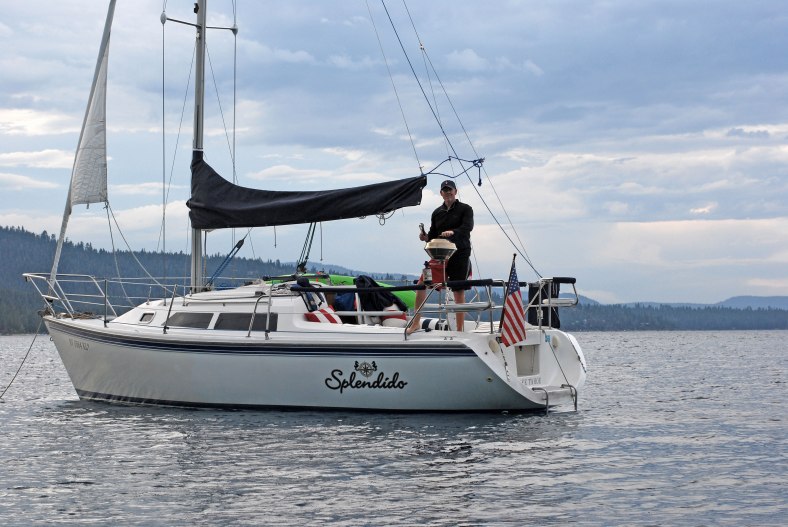
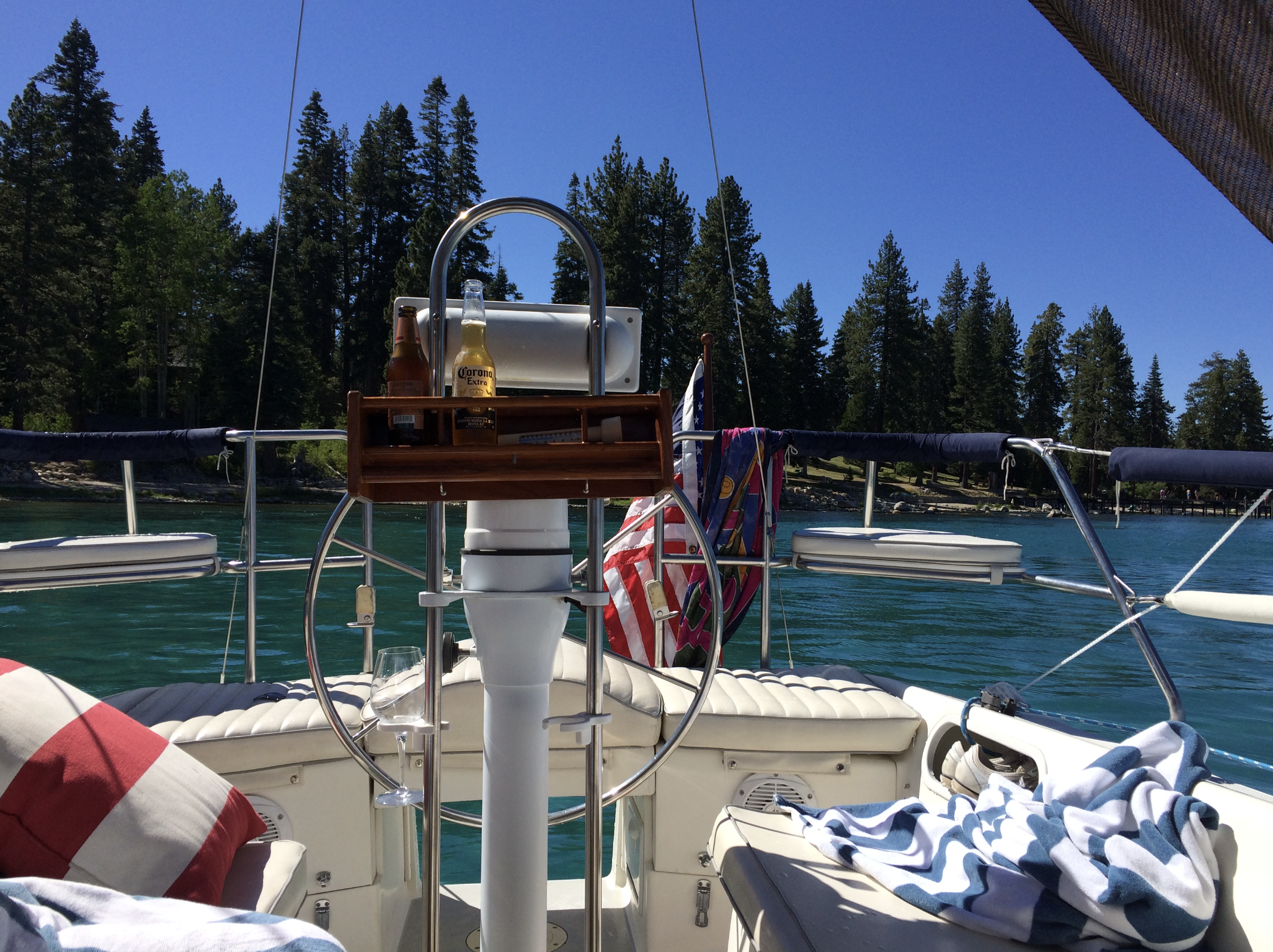
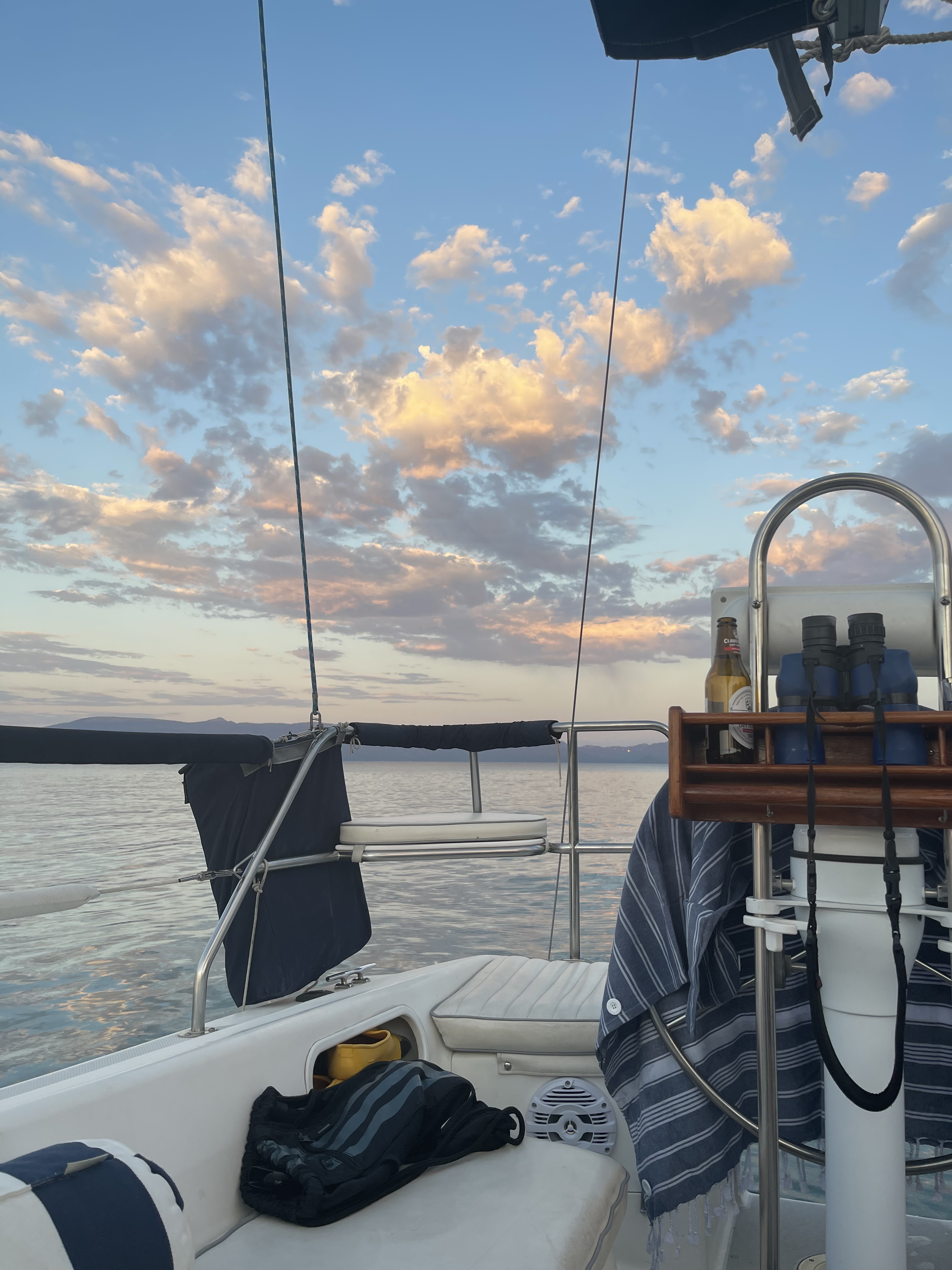
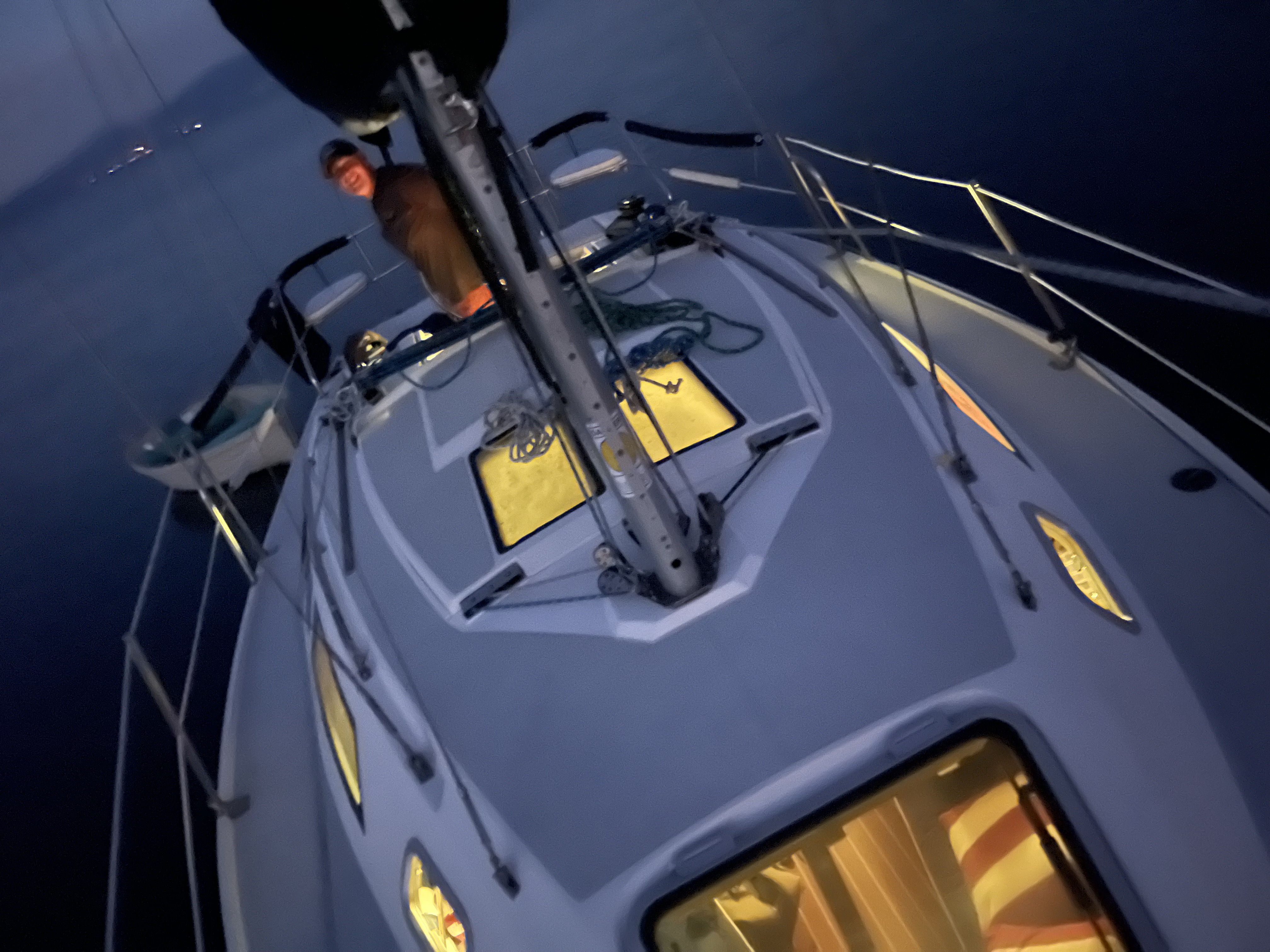
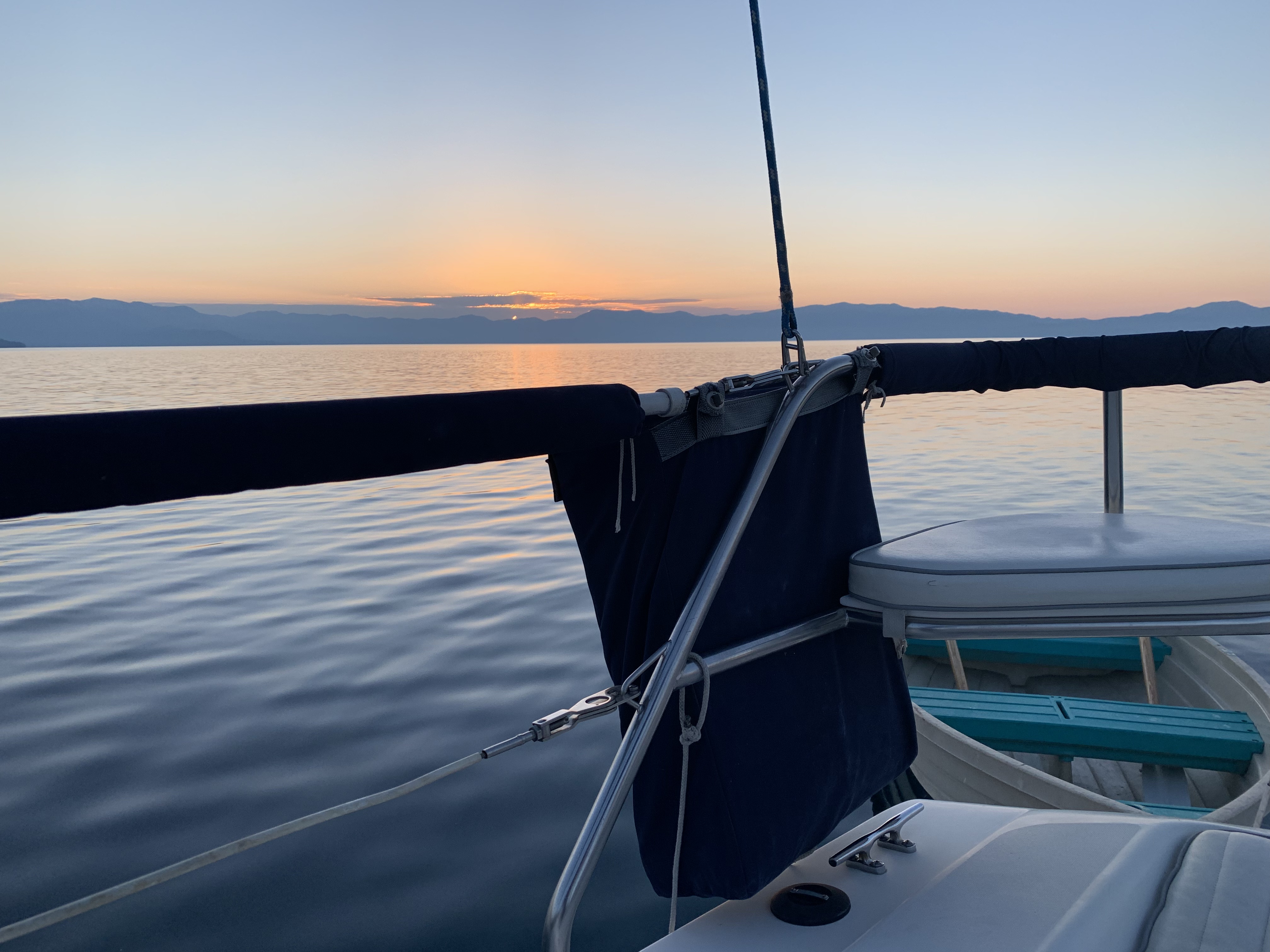
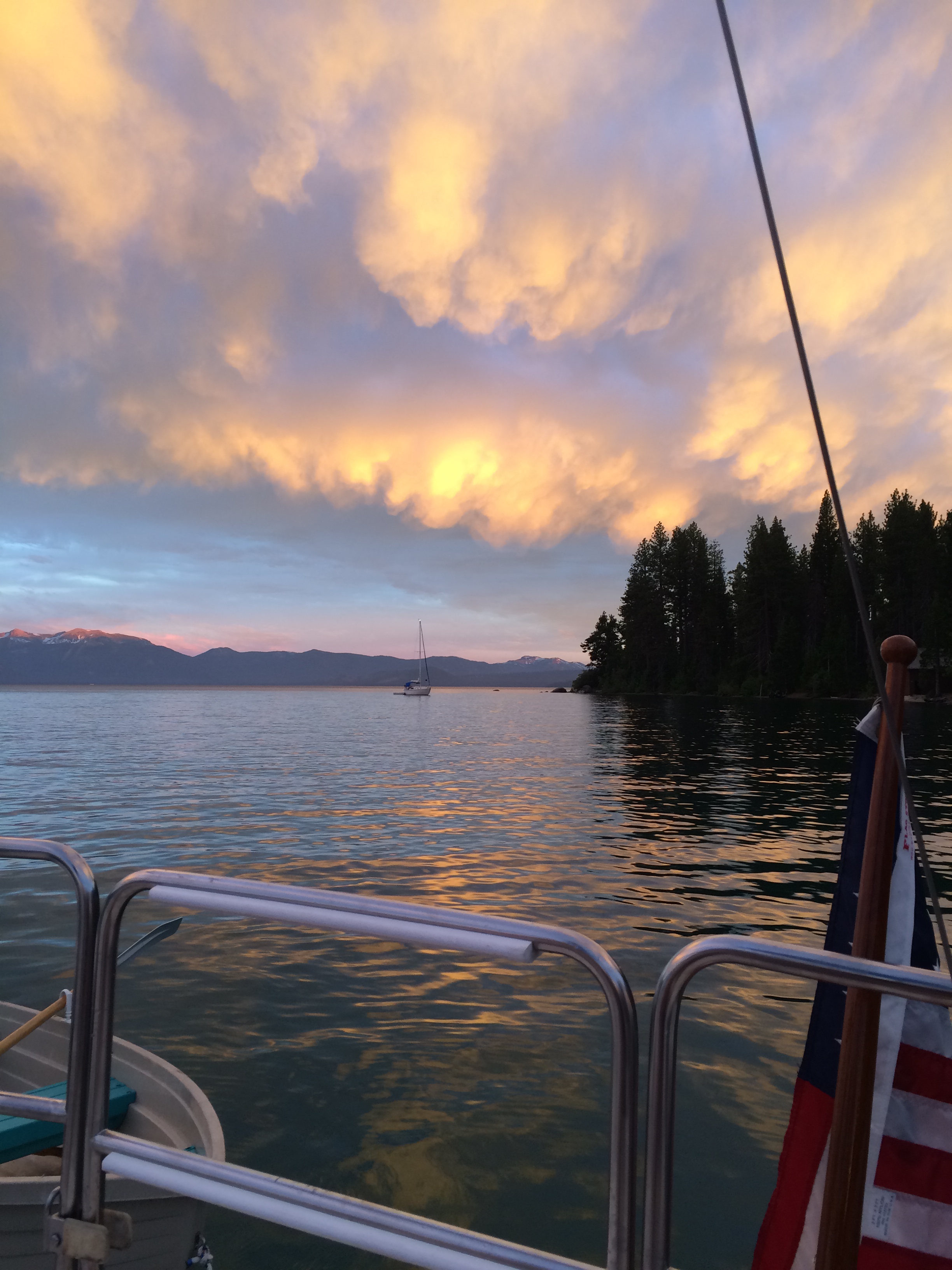
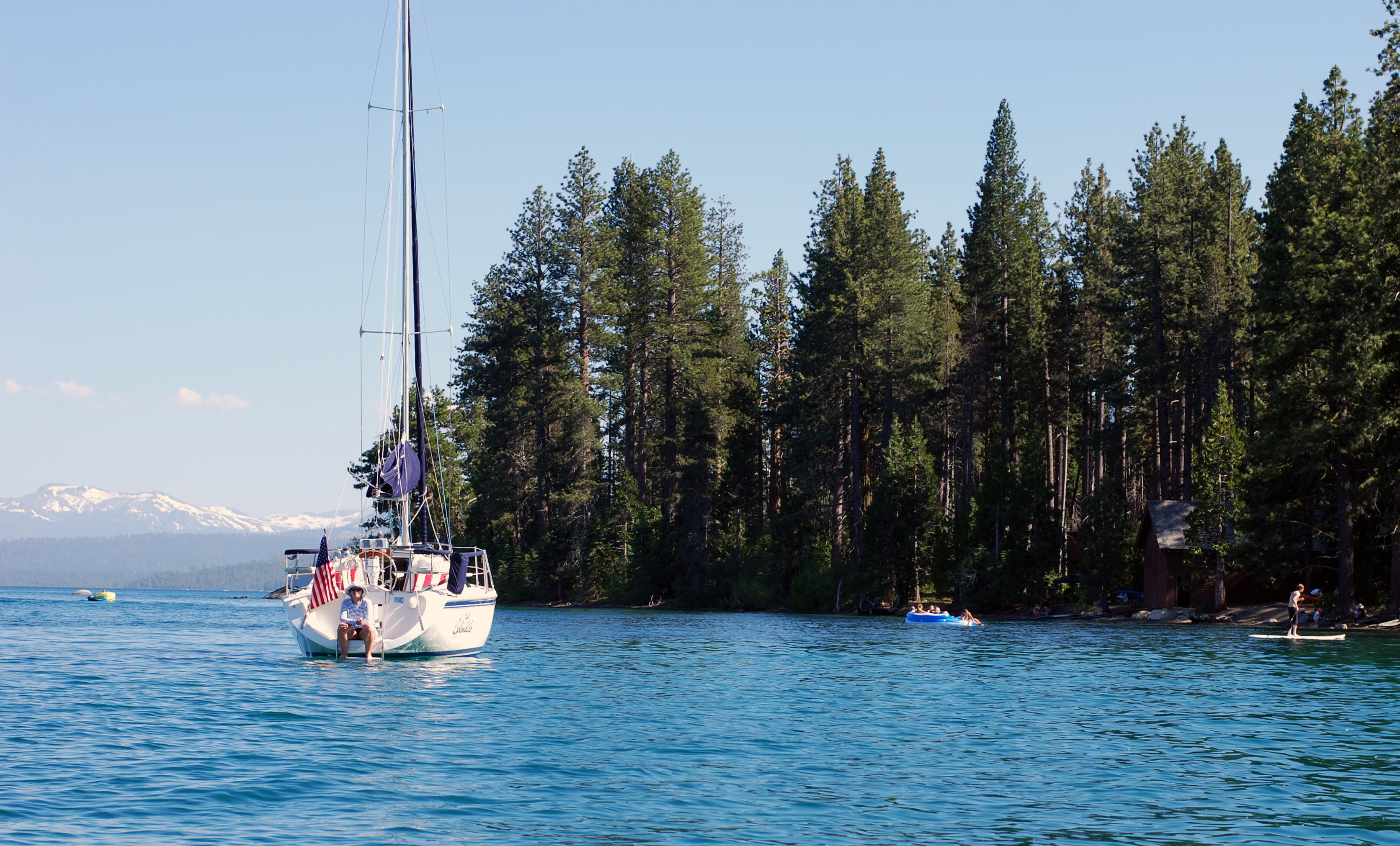
We put down both hooks and waited for the wind to die down. Jamie whipped up his legendary sea bass while I got things organized stem to stern. The food was tasty and filling, and we watched the colors change as the sun went down and a few paddleboarders ghosted by.

Day Two — Calawee Cove, D.L. Bliss State Park
Lat 39º 00 00” N
Lon 120º 05’ 53” W

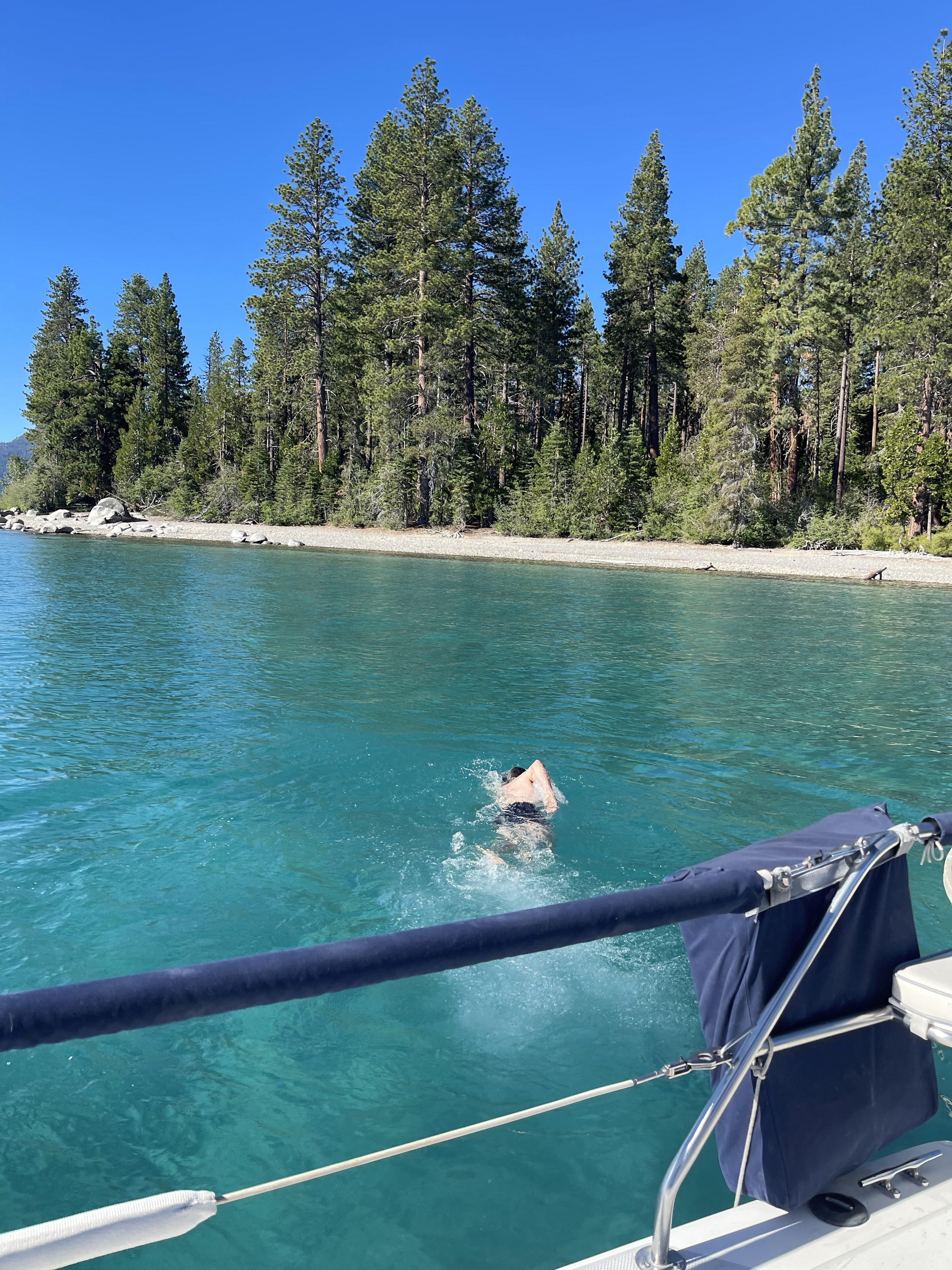
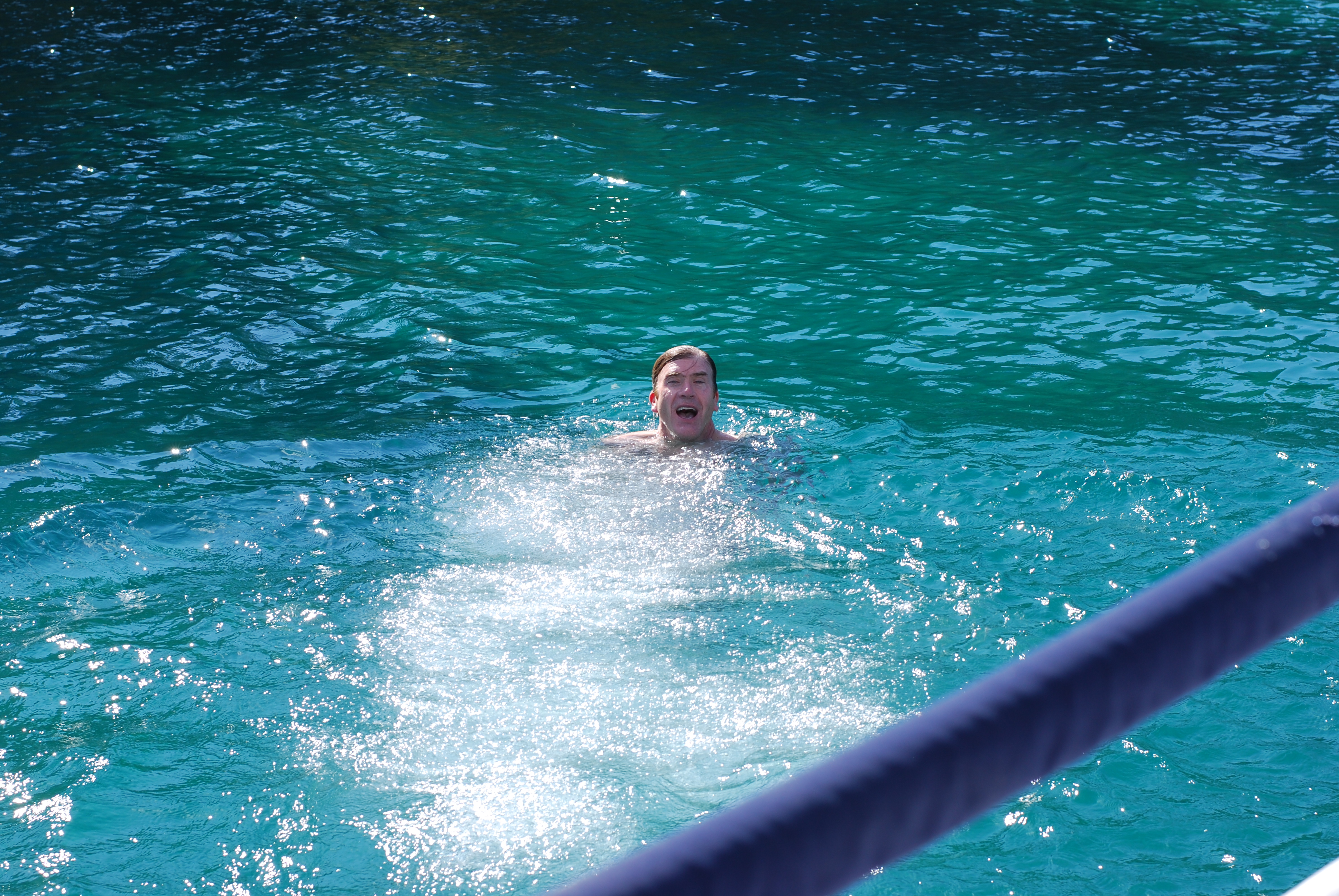
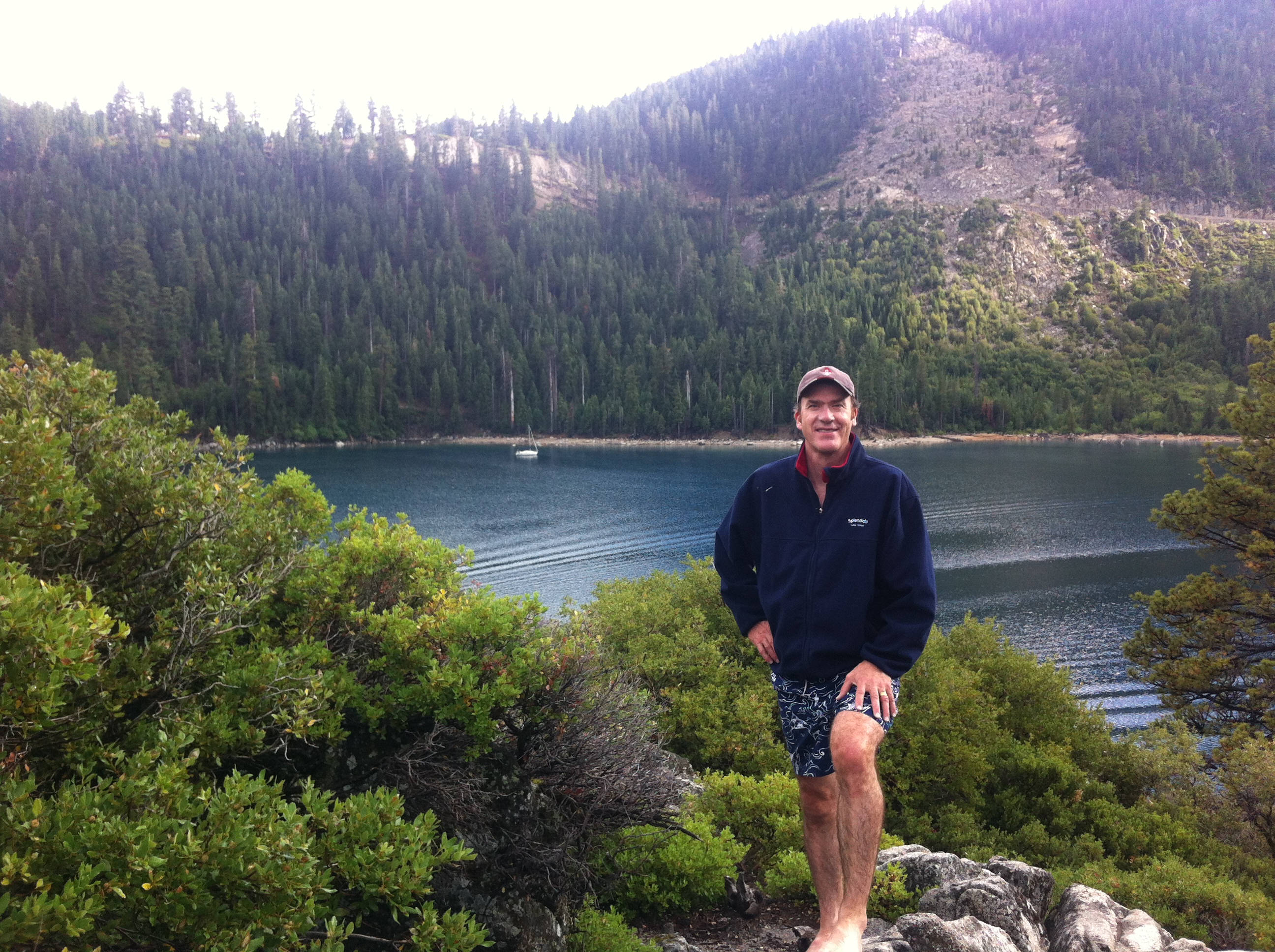
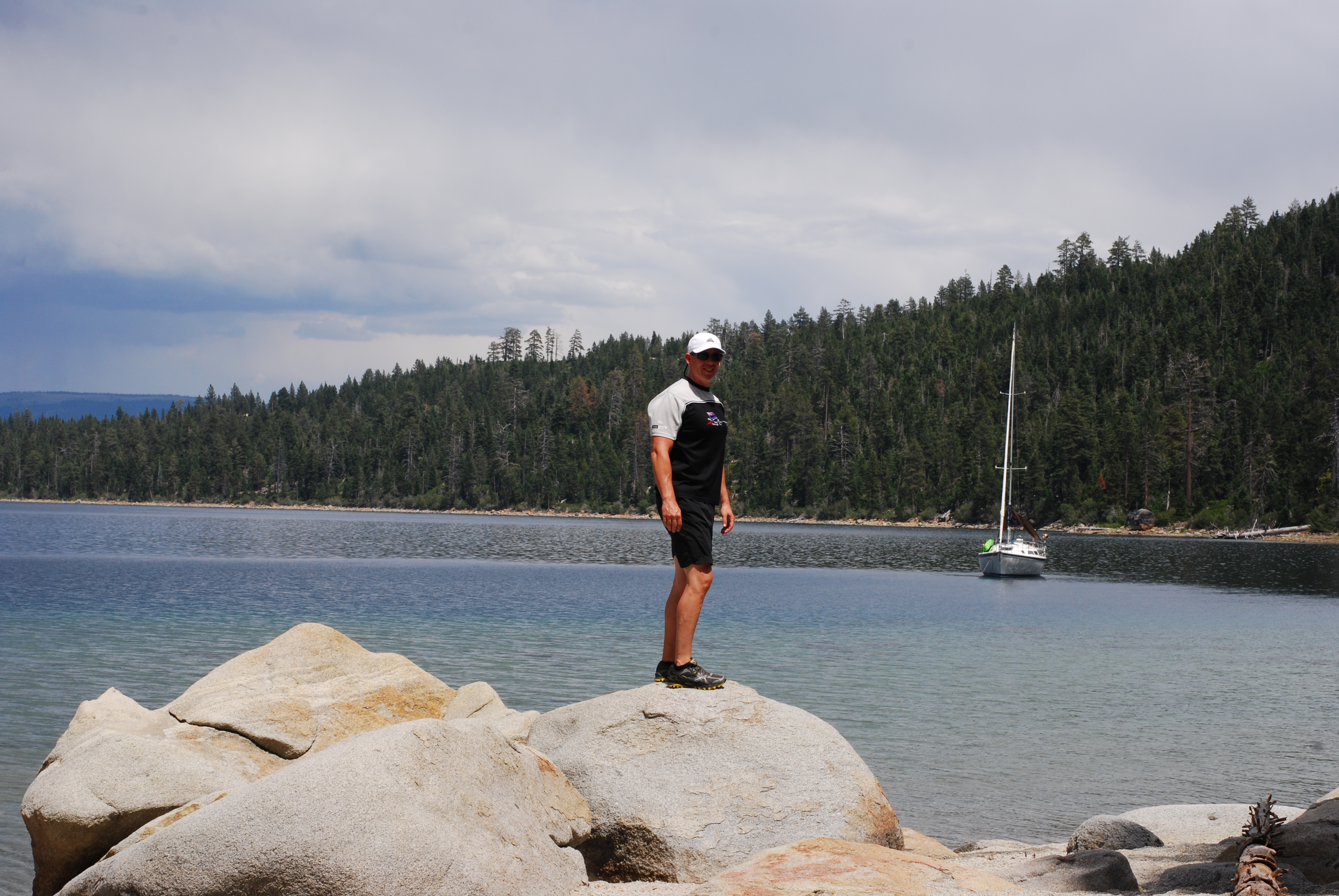
Woke up to a millpond-still Lake Tahoe. Brewed a pot of Blind Dog Nevada Black coffee and sat back while a few early risers jogged and did yoga on shore. Jamie went out for a paddle in the kayak, and I went for an early morning swim to wake up. I’m kind of funny about swimming from the boat to the shore; not sure what that’s about. I swim a half mile or a mile in the pool at the gym regularly, but I get a little nervous swimming open water for some reason. Maybe it was the coffee. Anyway, I relaxed into it and made it to shore, then hiked up the trail to see the view from Rubicon Point. I clambered up the rocks barefoot and just reveled in the scenery as Tahoe was so calm at that early hour.
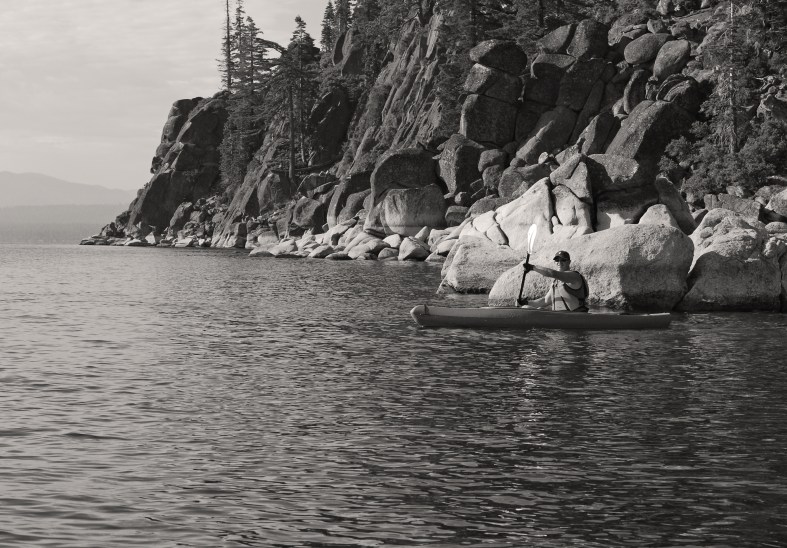
Jamie paddled his bright green kayak back up Rubicon Bay to check things out to the west. As I stood there in my dripping swim suit, I remembered that some campers had seen a black bear come down the Rubicon Trail the evening before, so I thought it might be a good time to beat feet back down the trail to the beach. I walked along the shore, feeling the warmth of the early morning sunshine on my back, and after about 15 minutes, Jamie paddled back in the kayak, and I swum alongside the kayak as we made our way back to Splendido. We each made our breakfast and relaxed for a while, but eventually the anticipation of getting to Emerald Bay overtook us (I was particularly curious to see if we could even get into Emerald Bay with our five-foot draft), and we buttoned everything up for the 3.5 mile motor down to the entrance.
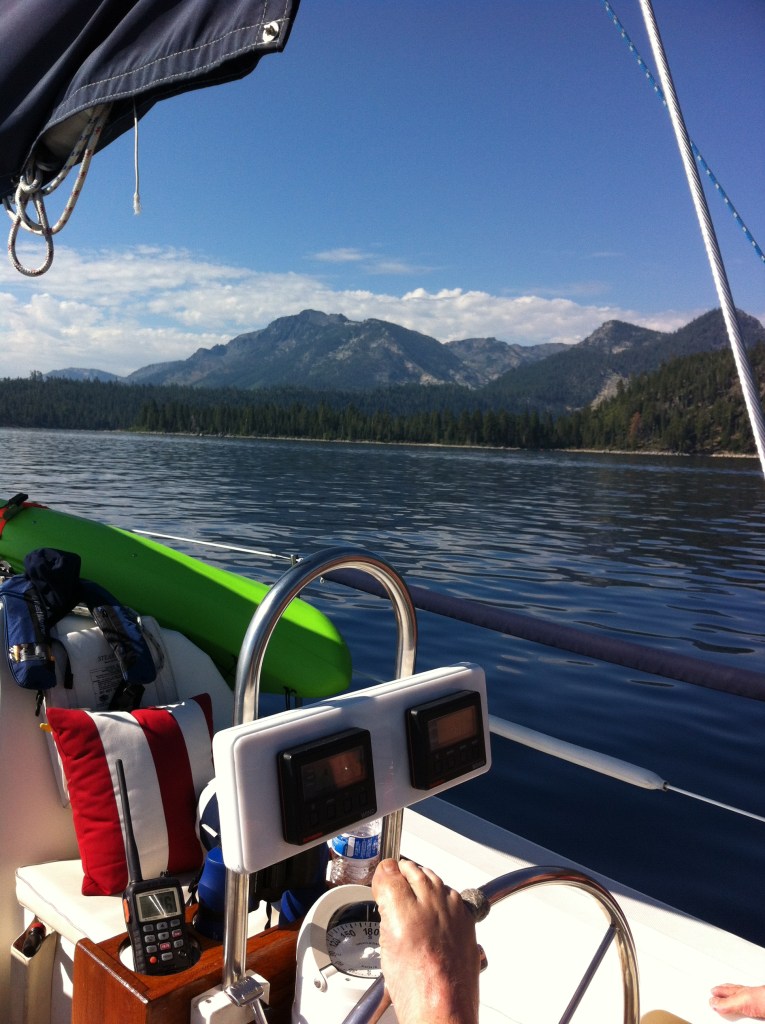
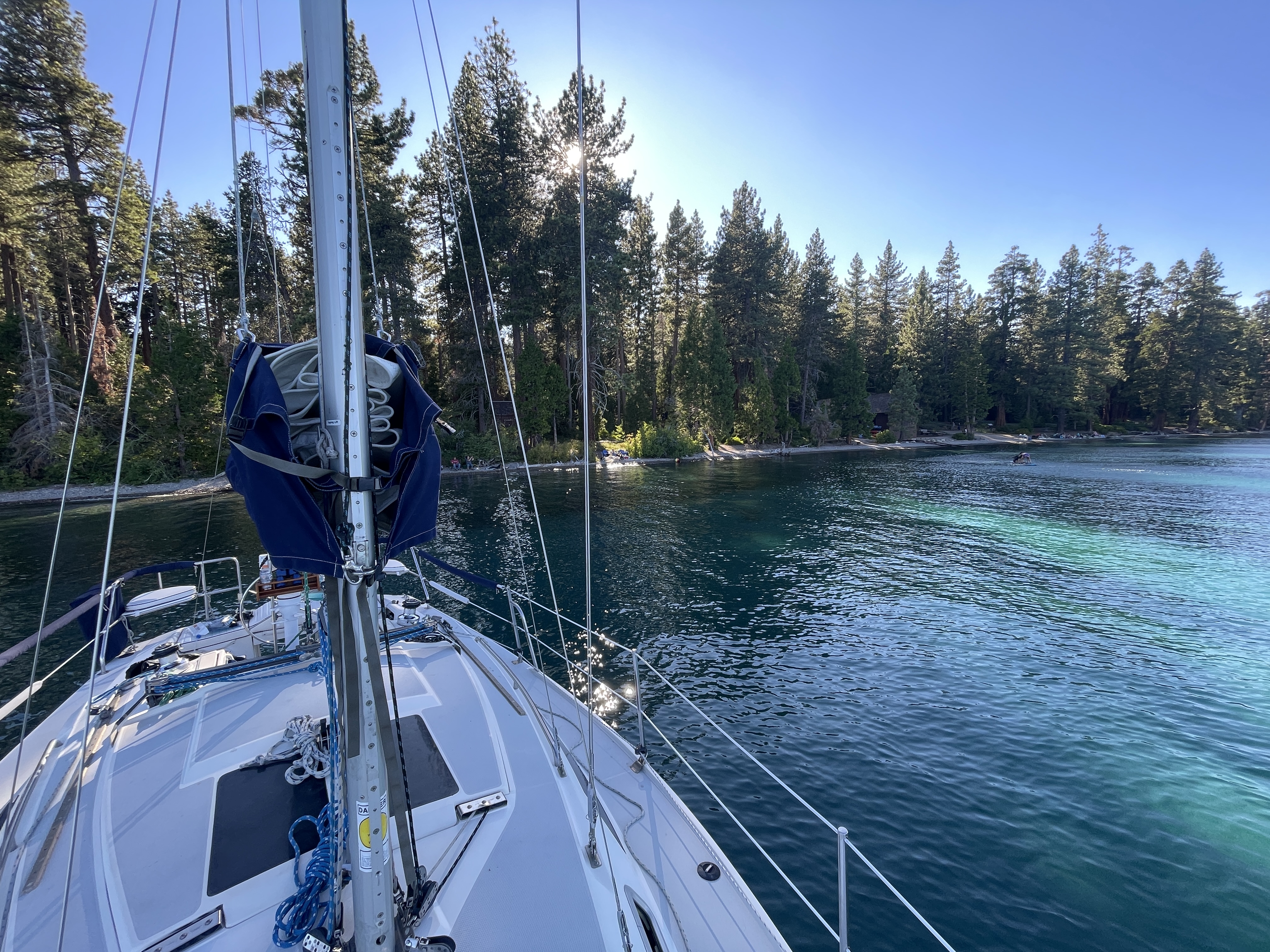
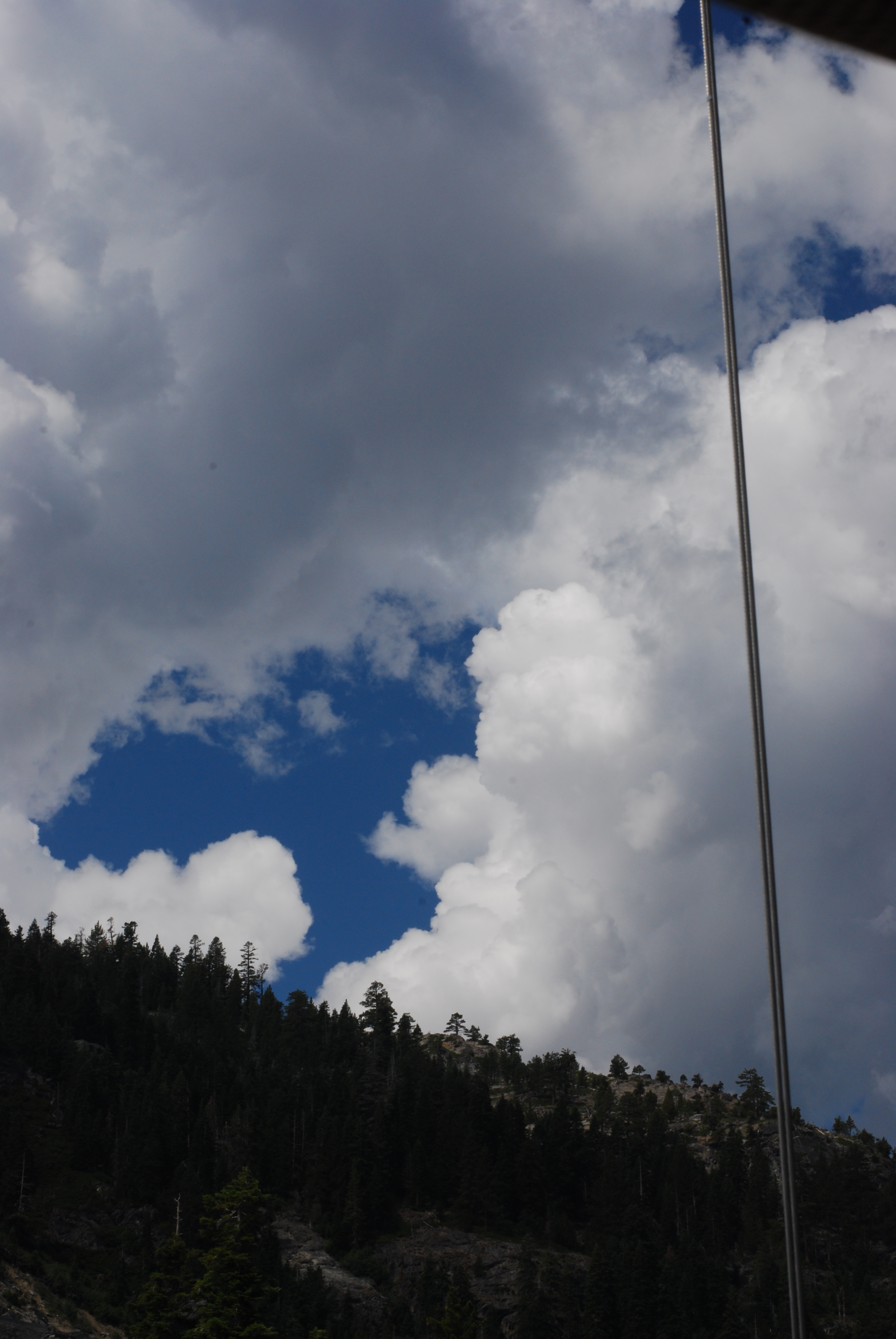
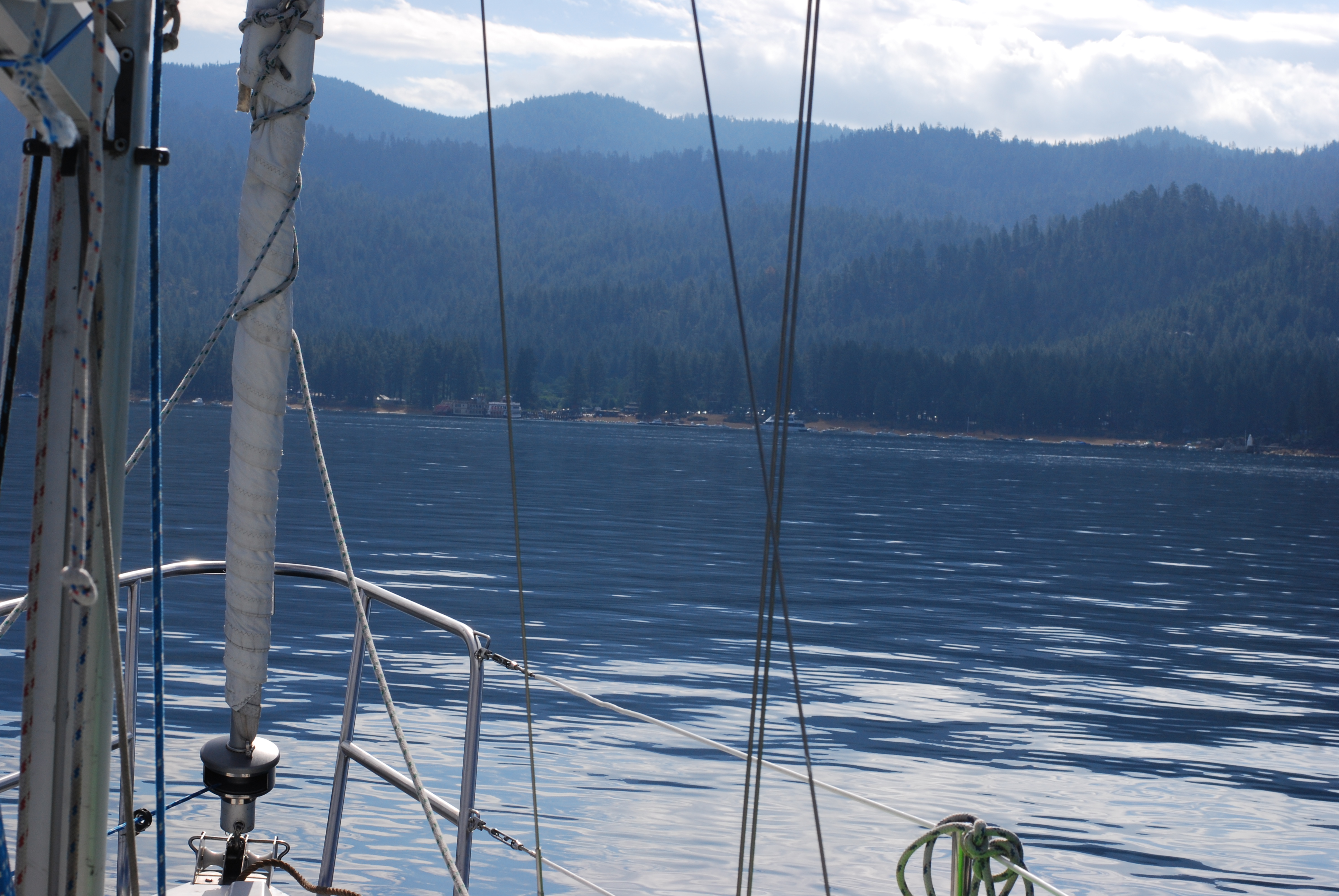
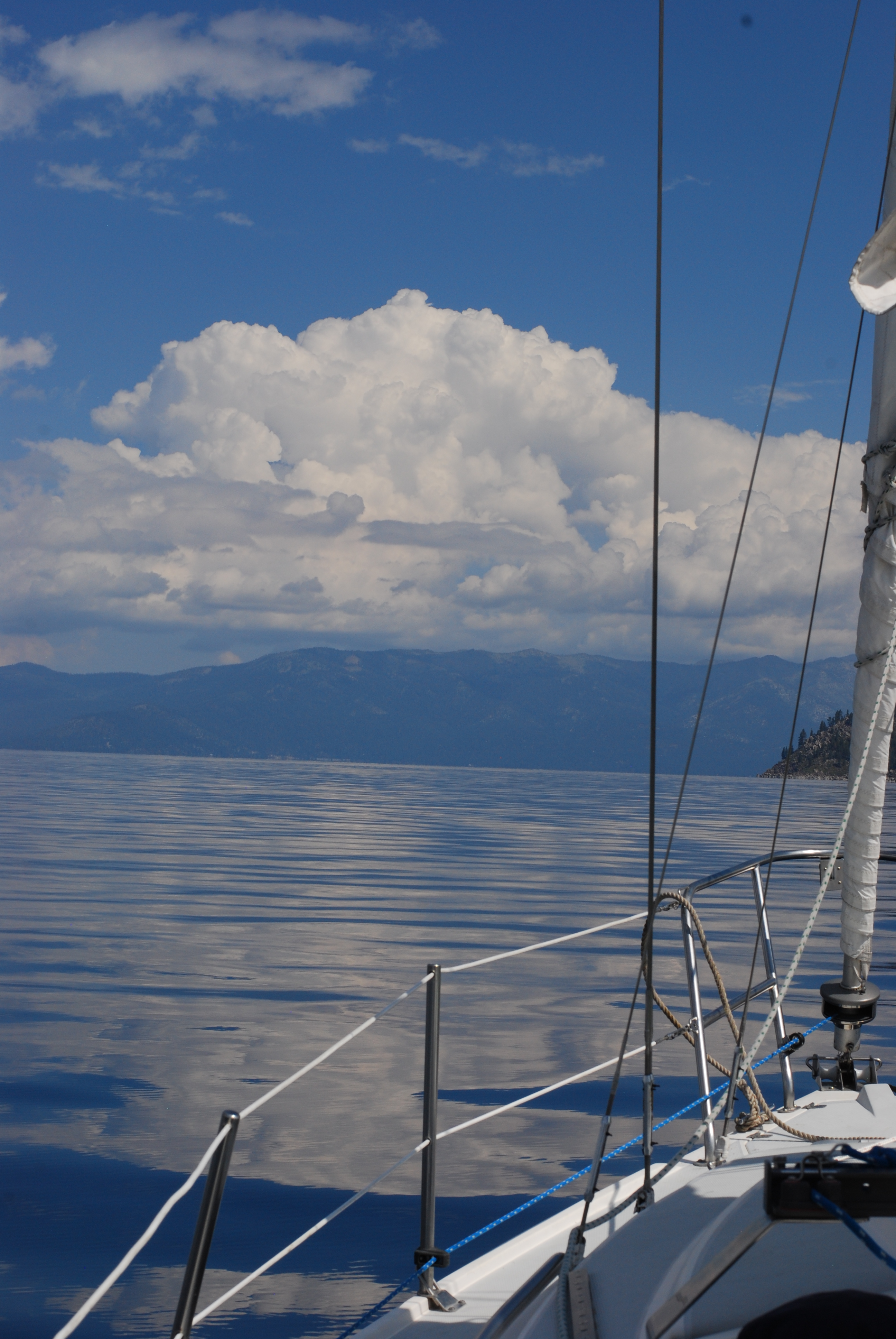
There is something magical about Tahoe on a summer morning. The water is still; the air is warmer than you’d think, and you have 360 degrees of wondrous views. Overhead, cotton-puff clouds were starting to accumulate, a precursor of the thunderheads forecast to form later in the day. The weather report called for rain in the afternoon with heavy isolated thunderstorms and flash flooding possible around the Reno-Tahoe area, so I felt Emerald Bay would be a protected place to anchor for the night. I hoped the water level was high enough to let us in the ¼ mile wide mouth, which has quite a sandbar spanning the entrance.
With Jamie on the bow of Splendido, we slowly made our way through the entrance as a flock of stand-up paddleboarders glided in from the Camp Richardson area to the south. The entrance may have been 6.5 feet deep at its deepest. Jamie gestured right or left to avoid a few dark rocks on the otherwise rippled sand bottom, and soon we were in the inky blue-black waters of Emerald Bay.
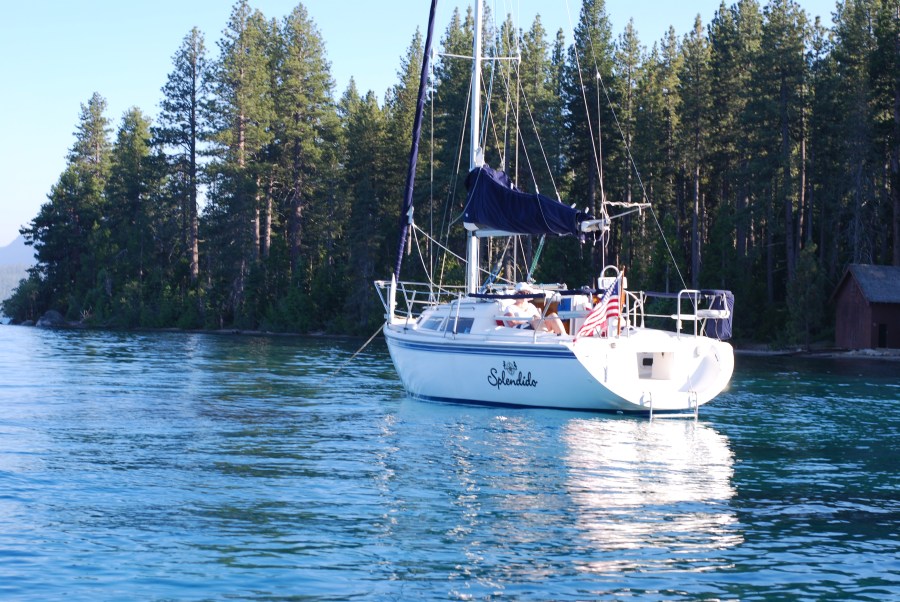
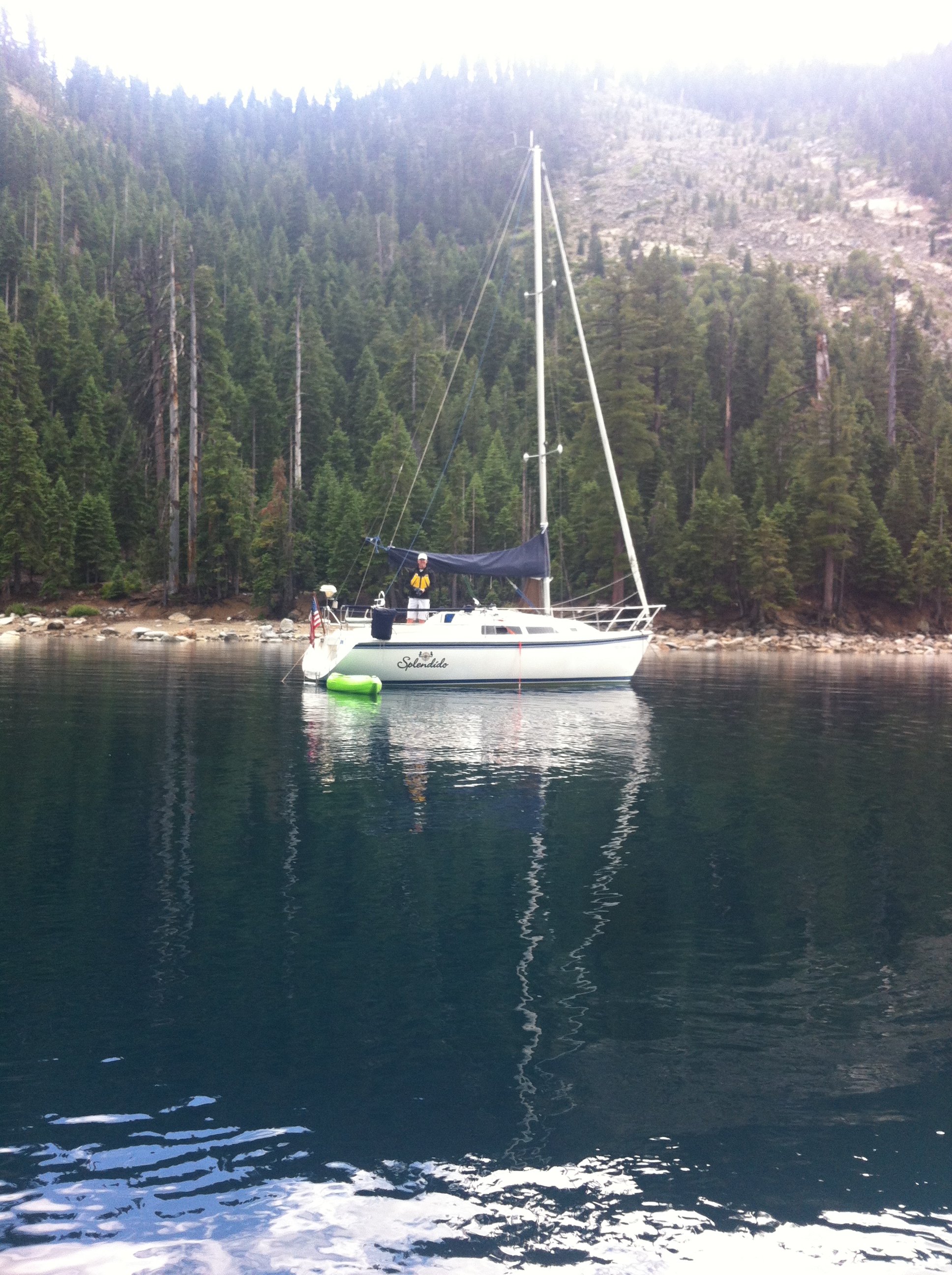
We glided past the buoys-for-rent campground on the north shore of the bay, where Debbie and I had spent the night several seasons ago, but I recalled that the winds across the bay had set up a whap-whap-whapping noise all night long that made it difficult to sleep. We continued past and saw a sailboat about our size anchored in a bit of a cove on the deep southwest side of the bay, so we scouted that area out and decided to double-hook Splendido there, with the nose pointing into the southwest.
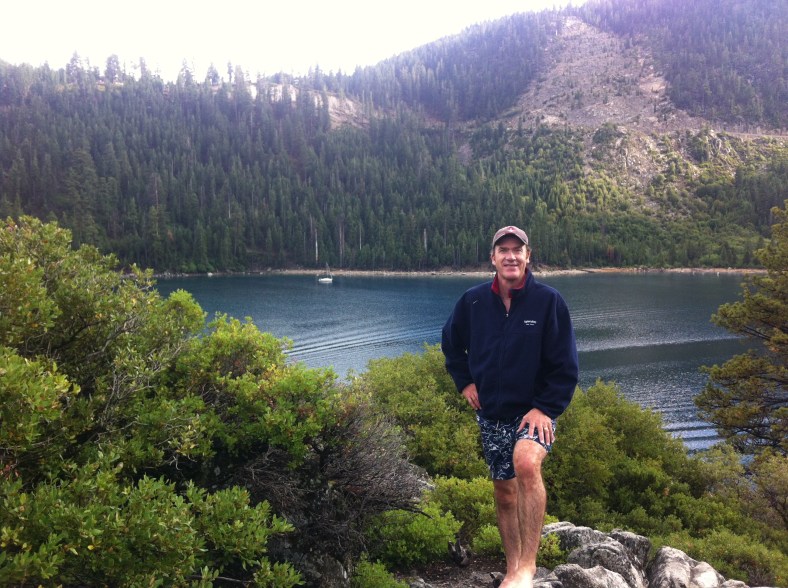
Day Two – Emerald Bay
Lat 38º 57’ 26”
Lon 120º 05’ 70” W
Once securely on the hooks, Jamie cooked up some mahi mahi burgers for lunch, and we both agreed that a nap was in order. I retired to my cabin aft and started reading Michener’s Chesapeake. I think I got in a page a half before I as out like a light.
When we woke up, we decided to take the dinghy into shore and hike to Eagle Falls, which, despite the fact that I’ve lived near Lake Tahoe for 28 years, I have never seen. The trail was well-trodden and the woods were unlike any that I’d traveled in the Sierra; it seemed to have a moister, more Pacific Northwest feel than many places I’d been to around the lake. A light rain began to fall, a sign of the weather forecast for thunderstorms with lightning that have been unusually prevalent this summer, and one thing I was concerned about on this trip. “Yes,” I remember thinking, “let’s travel around a stormy mountain lake with a 30-ft. lightning rod for a week.”

We arrived at Eagle Falls just as the rain began falling a bit harder. We snapped a few souvenir photos and beat feet down the trail to check out Vikingsholm, the Nordic-inspired manse at the foot of Emerald Bay. We poked around the house a bit, then visited the gift shop, which has a nice exhibit on the house and life around Emerald Bay in the early 20th century, when it was a bit more challenging to get to than it is today.
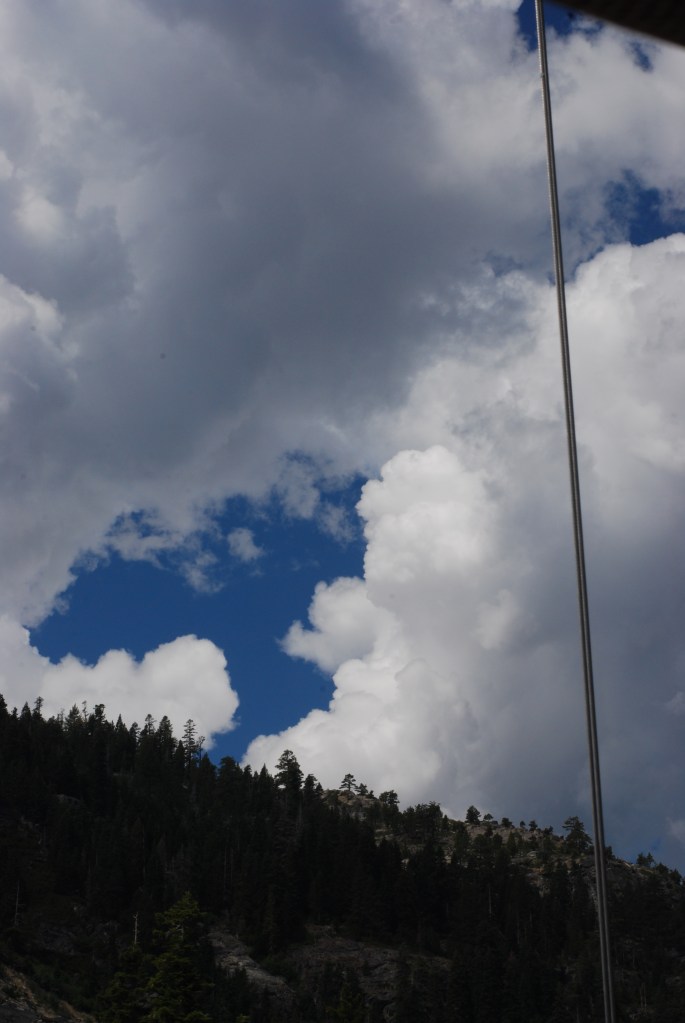 Outside, as the storm clouds gathered around other parts of the lake, it was partly cloudy over Emerald Bay, and lots of kids (and a fair number of adults) were running off the dock just north of Vikingholm and doing “cannonballs” to see who could make the biggest splash. Seeing Splendido about a quarter of a mile away near the southwest corner of Emerald Bay, Jamie and I decided to take the beach path around to where we’d pulled the dinghy up on the sand. Along the way, we checked out a couple of lean-tos that kids had made to play in, and picked up a bit of litter along the way as well. Seeing litter at Lake Tahoe always drives me crazy, but that’s a story for another time.
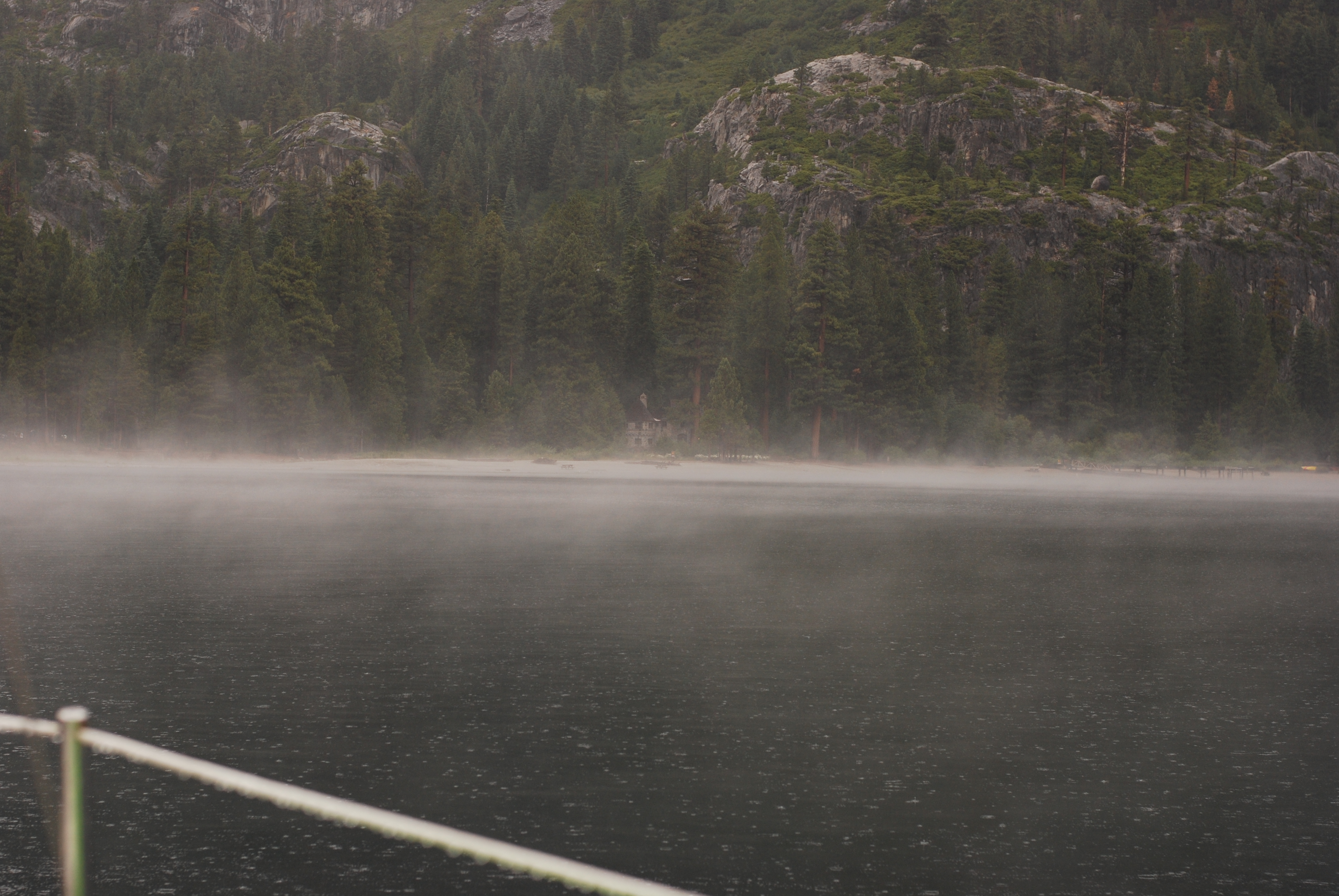
We rowed back to Splendido and tidied up the boat, pausing occasionally to look out the companionway to see what the weather was doing. Huge gray-black clouds started rolling in from the west and, oddly, from the northwest, creating kind of an apocalyptic feel as the rain began intensifying and lightning began to flash around the bay, with booming thunderclaps right on its heels. The rain turned to pelting hail, and soon the entire bay was jumping like sautéing garlic from the hail hitting the water. The sound of the hail hitting the boat was intense, but I was more worried about the lightning. Jamie didn’t seem particularly concerned, having worked for a lightning-rod company for 17 years, and having gone on many a lightning-chaser mission during those times. After about 20 minutes the hail and rain let up, and we emerged from the cabin. Emerald Bay was steaming all the way across, as the hail had dropped the air temp into the 40s and the water remained about 65 degrees. Within an hour the dark clouds had rolled on, leaving overcast skies with a bit of blue sky showing through to the west. Now, the bay was empty and the water flat as a mill pond, so we decided to paddle over to Fannette Island and visit the famous tea house perched atop the rocky isle.

I counted 200 strokes in the dinghy from Splendido to Fannette. Jamie paddled easily in his kayak, and soon, we were dragging the boats up the granite rocks to secure them while we hiked the remarkable rockpile that’s likely one of the most photographed islets in the world. I forgot to bring my boat shoes, and being barefoot, I picked my line gingerly among the rough granite steps and pathways that wound through fragrant bushes, still damp from the rain and hail. The rocky isle smelled of loamy earth and pine as we climbed higher and higher, splashing through puddles along the well-worn trail to the top. I tried to envision parties of little old ladies making the hike to the tea house, and imagined they’d probably had a nip of brandy in addition to their tea to restore their constitutions after the climb.
We reached the tea house, which is now roofless and windowless (I don’t know if it ever had either a roof or windows, but there were wooden window frames, so perhaps it did.) We looked out over a deserted Emerald Bay, save for a few hearty sailors like ourselves on the northeast corner of the bay, who had rented mooring balls for the night. It was nice to have the whole place to ourselves, so we climbed out the tea house window onto the surrounding rock and just sat, taking it all in. After getting our fill, we clambered back down to the boats and slowly made our way back to Splendido, rowing quietly through the misty air, and talking about life and work and relationships and how great it was to step back from it all with an adventure like this. We leaned on our oars and drifted around ever so slowly, chatting away and just enjoying the quiet majesty of the place, with its soaring peaks all around, and lush greenery lustrous after the rain.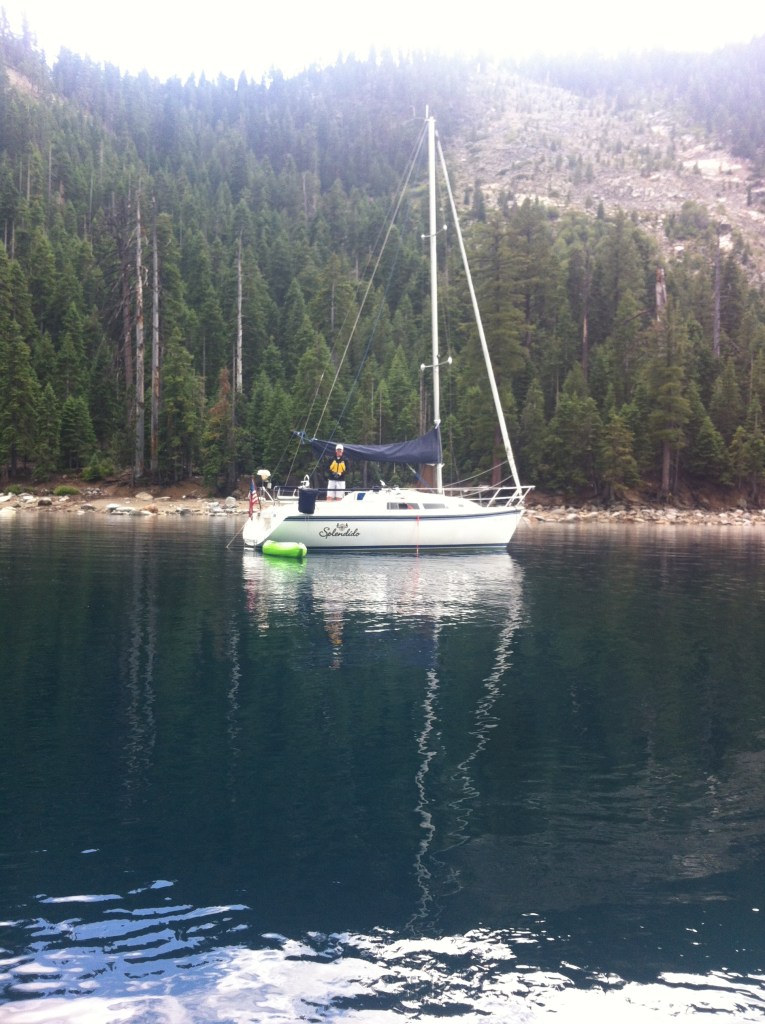
Back aboard, Jamie grilled a couple of thick steaks and dished up some excellent “superfoods” salads along with thick, crusty bread. He’d been in cell contact with his folks back in Wyoming, where some serious health issues meant that one of his parents would need surgery in the coming weeks. As the sky darkened overhead, I could sense that Jamie was increasingly feeling the pull to get his travel arrangements made and get out to Wyoming to help his folks.
At the outset of the trip, we had agreed on a “shotgun” clause: If either one of us wasn’t having fun or felt the pull of “real life” interfering with the circ, we would call it a day and head back to our home mooring at Hurricane Bay. This was one of those moments, so we talked about it after the dishes were done and we’d crawled into our bunks. I was bummed that the weather was an issue; Jamie felt the pull of family responsibilities. Jamie asked me if I’d be OK foregoing the complete circ and just head back north up the west side, the way we came. I said I’d be disappointed, but I owned that being chased by the weather could become an issue, especially on the more exposed east shore of the lake, where there were only a few safe harbors to duck into if things got crazy. Jamie admitted he was feeling the pull of family obligations, and would like to wrap up the trip by Thursday at the outside. We decided to get a good night’s sleep and decide in the morning. I was glad we had the frank discussion, and slept like a log.
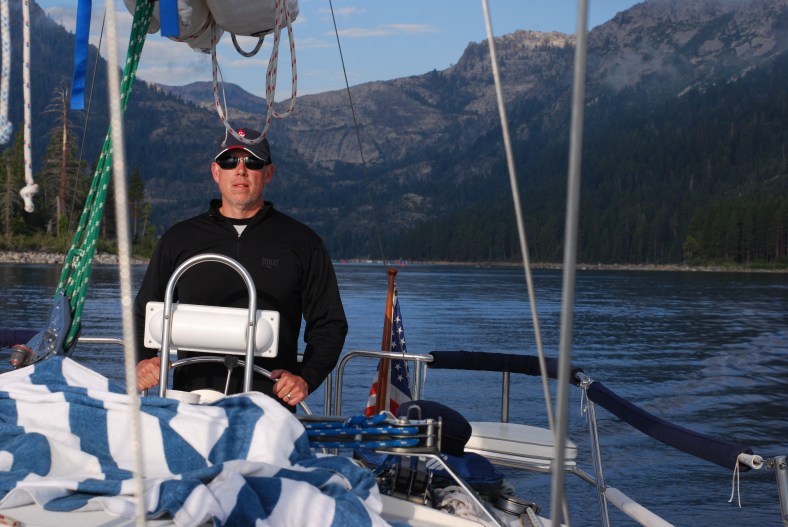
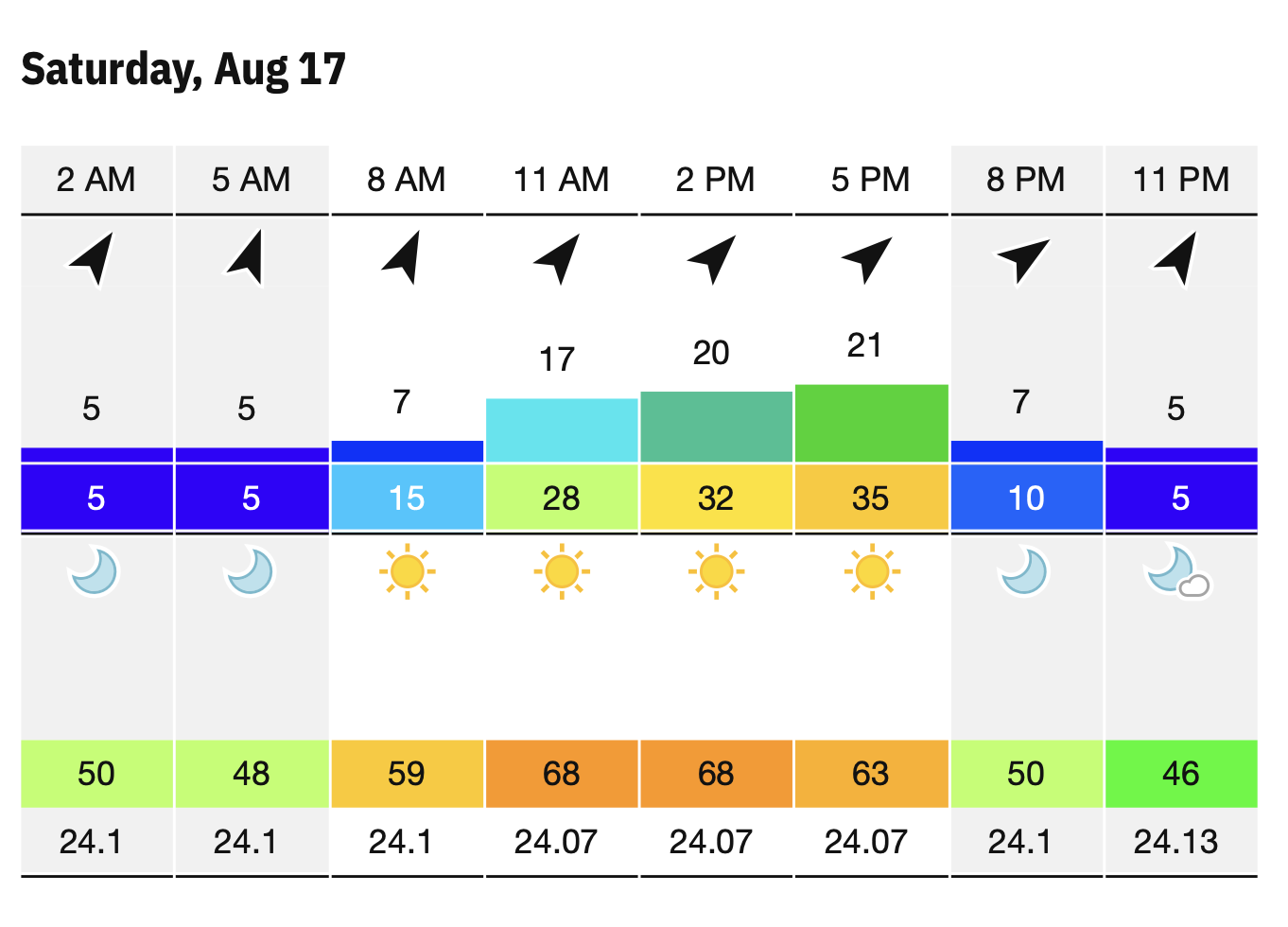
The morning broke with beautiful clear skies and flat water, so —invigorated by a good night’s sleep — we made coffee, weighed anchor, and decided to just go for it. We motored across the lake to Zephyr Cove on the east shore, where I wanted to top off the diesel fuel just for safety’s sake, in the event we found ourselves needing to motorsail if a storm kicked up later in the day. The weather forecast indicated scattered thunderstorms in the afternoon with punchy outflow gusts with a prevailing wind direction out of the southwest, so I was anxious to get to either Skunk Harbor or Sand Harbor before weather became an issue.
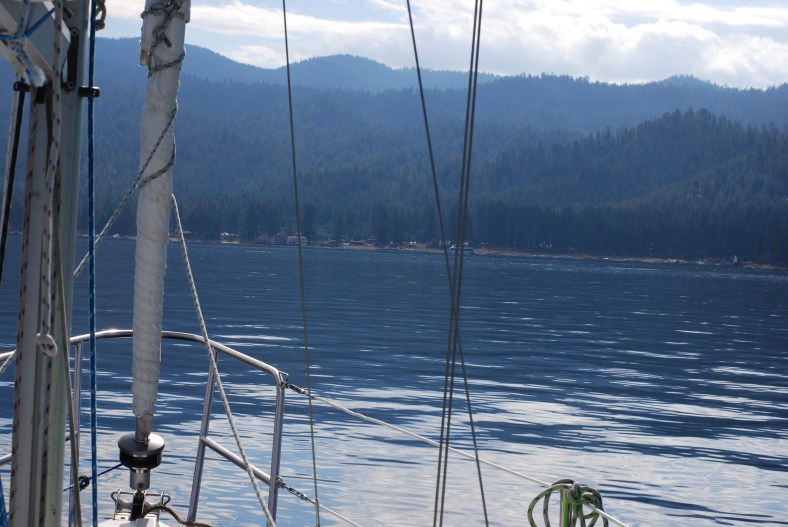
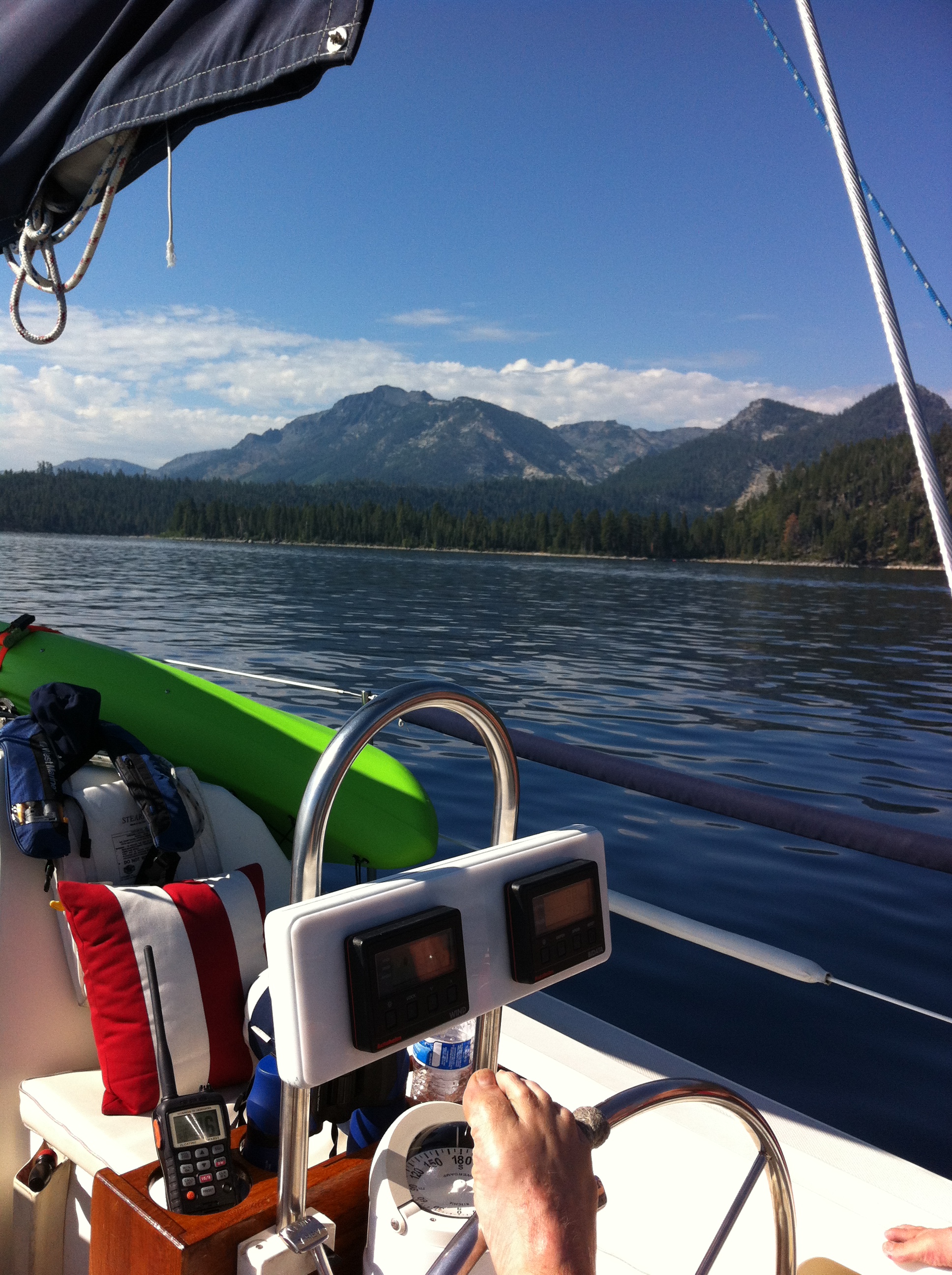
The ride across the lake was amazing, with hardly a breeze stirring as we experienced that “hot air balloon” feeling of riding across Tahoe’s crystal-clear waters. We grazed on Kind bars and roasted almonds for breakfast, and I sipped my second cup of coffee as we just took in the sights all around us.
Day Three – Zephyr Cove
Lat 39.0021° N
Lon 119.9560° W
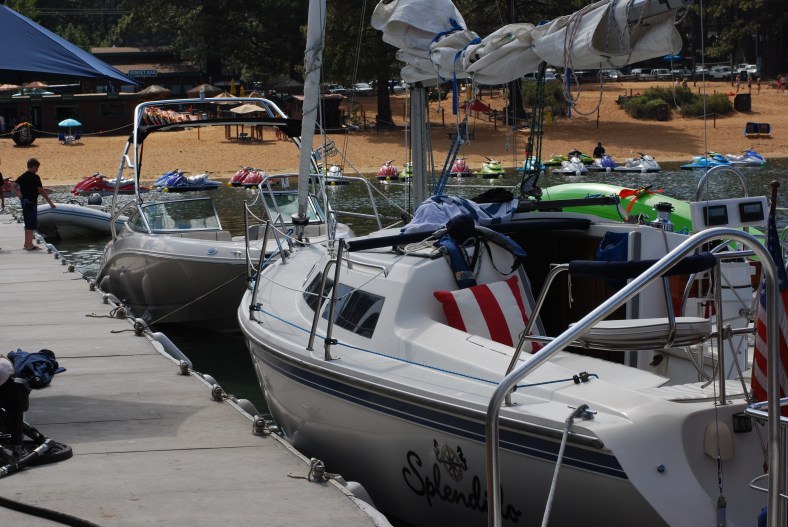
As Zephyr Cove came into view, we set our sights on the boat dock where the Tahoe Queen was moored, thinking that was where we’d likely find the diesel pumps. We got within about 30 yards of the dock, and noticed that the staff was sort of wandering around. A few random speedboats were tied up there, their owners having stepped ashore. We idled patiently waiting for someone to notice, and at length, someone on the dock hailed us and asked us to wait until one particular speedboat was towed out to a mooring ball. I was idling and sometimes circling Splendido while we waited, and I kept glancing to the west to see if the forecast thunderclouds were stacking up. Over the 40 minutes we were idling, the skies in the west turned from clear blue to wispy cirrus to piling accumulations of thunderclouds. Finally, we got the go-ahead to bring Splendido into the dock, and as we were ghosting in, she started to drag her keel in the sand and just stopped dead. I was a little antsy after all the waiting, but after a few choice words, Jamie and I both stood on the port rail and tipped the boat to one side while I gunned it in reverse. After a few seconds of kicking up sand, she came unstuck, and I steered her back into deeper water. A friendly charter captain nudged his long wooden boat forward and had us come in from the deep side on our second try, and we glided right up to the dock. I jumped off and got her tied up. A cheerful young woman topped off our diesel tank, and soon we were happily motoring out of Zephyr Cove and northward toward Skunk Harbor.
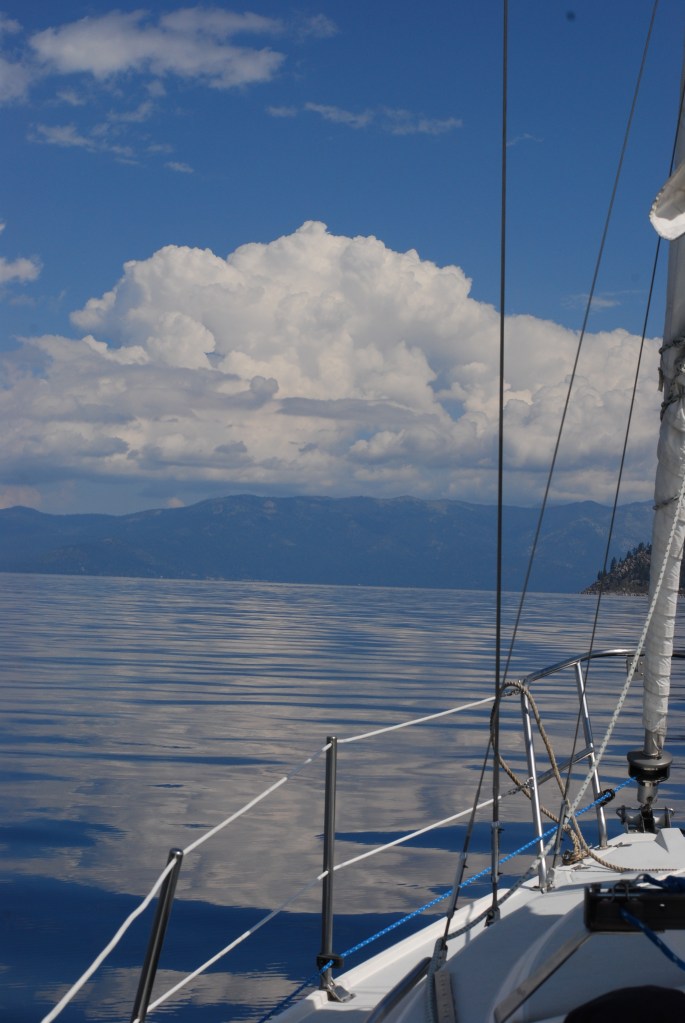 By now, it was a quarter after 10 a.m. and the clouds were starting to line up along the mountains to the west. My main concern was to get to Skunk Harbor before the forecast winds kicked up, to see how protected a harbor it was from the prevailing winds, particularly in the event of strong, sustained winds and waves from the southwest. On the chart, it looked like Skunk had a nice headland that protected a shallow cove, but I had never been there, so I was eager to see whether it would be a good place to anchor for the night. Everything looked OK from the chart, but I had sailed along the east shore some years ago in a Catalina 22 in some pretty good chop that had built up over the long fetch from the southwest corner of the lake, and I remember it being a heck of a bumpy ride. If the headland didn’t protect Splendido from the swell, I know I would have a tough time trusting that our two anchors would hold — not to mention trying to cook or even sleep aboard a rocking and rolling boat.
Day Three – Skunk Harbor
Lat 39° 07’ 50” N
Lon 119° 56’ 45” W
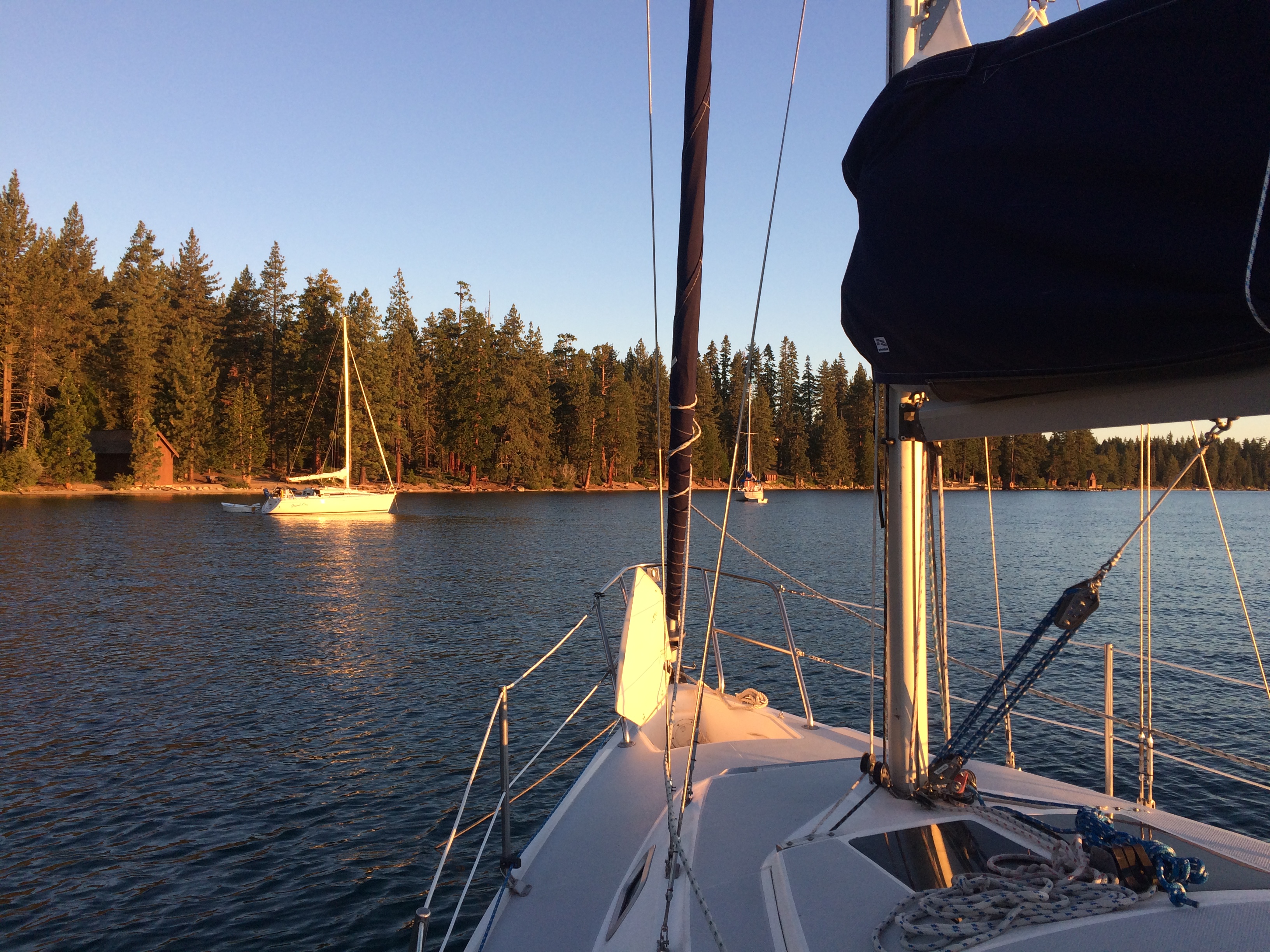
We glided past Glenbrook and around the corner to Skunk Harbor, arriving around 1 p.m. Once around the headland, we spied a beautiful little cove that looked like it would be quite protected from southwest winds. The bottom was gorgeous white sand, and we angled Splendido in to set anchors fore and aft, anticipating that if a storm did come up, we’d stay pointed into the SW and everything would work out OK. After setting the front anchor and setting it firmly, I took the second anchor in the dinghy and rowed out about 150 feet, dropping the hook to the northeast. Back on board, we heaved until the secondary anchor dug in and Splendido lay taut between the two anchors, pointing perfectly into the southwest.
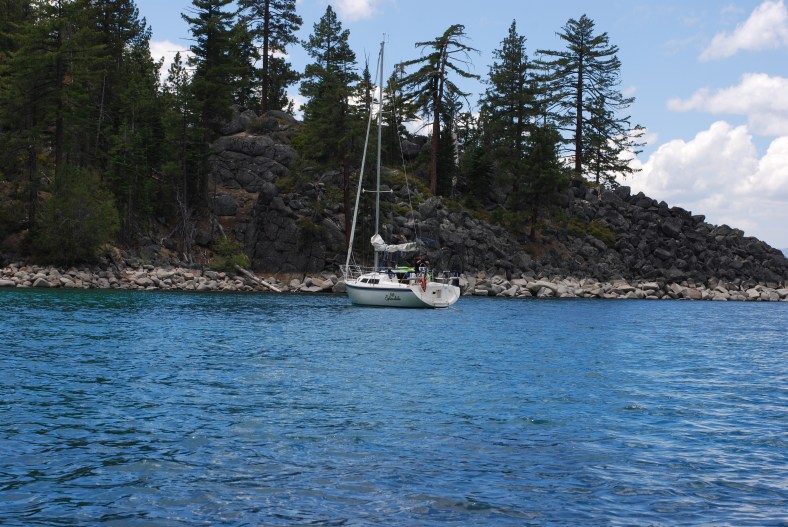
We went for a swim and had lunch on board, followed by some exploring around the cove. As the afternoon wore on, I felt that this would be a safe place to protect us from southwest winds and waves that might come up, so I relaxed a little and went for a row further east into the cove to see what else Skunk had to offer. I discovered that Skunk is actually a succession of mini coves defined by rocky outcroppings, with two of them large enough to accommodate Splendido — the one we were currently anchored in, and the “final” cove at the east end, which had a public beach and what looked like a residence on the water to the south. I rowed the dinghy around a bit, but it looked like it would be tricky to get Splendido further in the narrow passage between the rocks if we needed to, so I rowed back out to see how she was holding up.
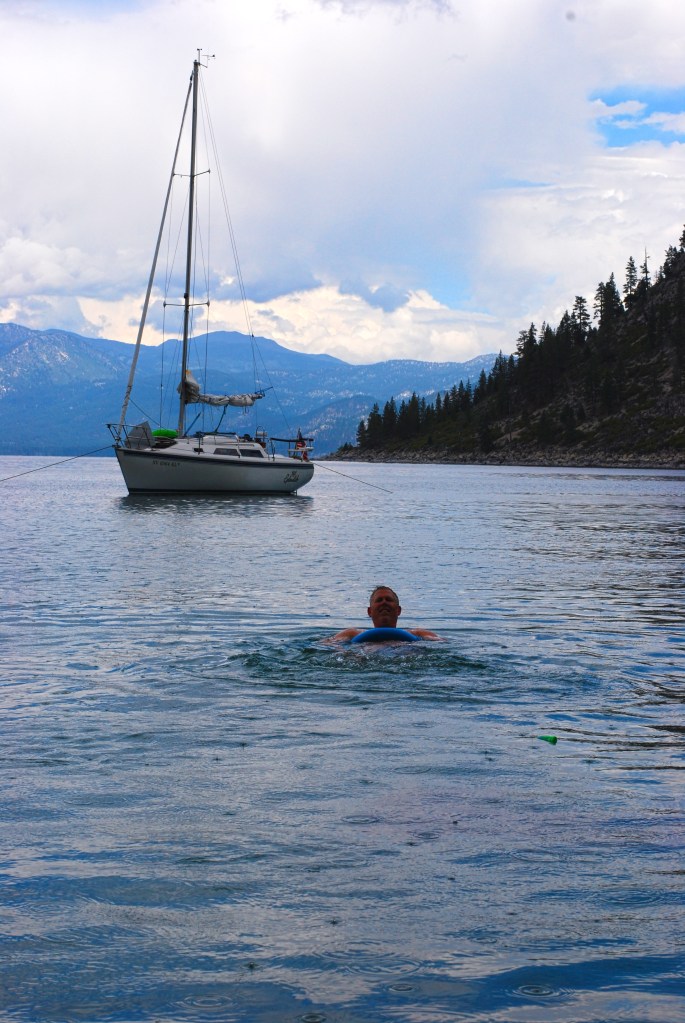
As I made my way toward Splendido, a sailor in a 25-ft. cat-rigged sailboat came near. I shouted out to ask where he was sailing from, and he said Carnelian Bay. I asked where he was planning to camp, and he said “maybe I’ll join you here” as he sailed out of range. At this point, the wind was really starting to kick up in the 20-25 mph range, and I realized, to my horror, that is was coming straight out of the west — not out of the southwest, as forecast. As I rowed near Splendido, I watched as the swells were coming straight out of the west, and Splendido, strung tightly between her two anchors, was taking the swells from the side, “bowing” both anchor lines and fighting the swells. I began to fear that she might drag the front anchor with this motion. If she broke free, she would quickly hit the large rocks near shore just 75 feet away.
An Event Cascade — And A Turning Point
A cascade effect is an inevitable and often unforeseen chain of events that lead to a system failure. I remember reading about that in Michael Crichton’s novel Airframe, and what happened next to our little circumnavigation, in hindsight, represents a cascade effect to me. Or, as my wife Debbie always says after things go wildly wrong: What did we learn from that experience?
When I clambered aboard Splendido, Jamie was below decks talking on the phone to his dad. They were deep in conversation, so I didn’t shout down to him, instead sizing up the conditions on the water and worrying that the front anchor was going to drag (even though Splendido seemed to be doing just fine, despite the unfortunate angle to the wind). Then I had an idea: What if I let out more line on the secondary aft anchor, so the tension was taken off Splendido and she pointed more into the wind to the west?
It seemed like a reasonable idea at the time.
I began to unwrap the anchor line from the aft cleat on the port side, and very quickly, Splendido seemed to point more into the wind coming from the west. The problem was, now she was dangerously close to the rocks near shore, and the water was so shallow underneath that I thought she might start smacking her keel on the sand. I panicked a bit — and dropped the anchor line into the water.
Oh shit, I thought. I’ve done it now.
I quickly turned the key to start the engine, which got Jamie’s attention. He quickly got off the phone with his dad and scrambled up on deck.
“What’s up, Woody Bran?” he said, calling me by the nickname he’d given me from our youthful tennis-playing days.
“I dropped the back anchor line as I was trying to let it out. We’ve got to go forward and pick up the front anchor now.” I said.
“You’re gonna have to dive for that dropped anchor line.” Jamie said.
“I know. I know.”
We pulled ahead and picked up the front anchor, then proceeded to motor in circles to try to spot the 180 feet of line and chain on the bottom of the cove. The tension on the line had caused the whole thing to snap back into deeper water. With the wind and chop, it was difficult to pick out the white line on the white sandy bottom. Finally, we caught sight of it.
“There it is,” Jamie shouted.
“I see it,” I said, pulling on my dive mask.
The line was in about 12 – 15 feet of water, so I grabbed the Type IV cushion as I went overboard, just to have some flotation in the event I didn’t get the line on the first dive. The water was cold, and it took me a minute to catch my breath before diving. I dove on the line, but by this time, my mask had fogged up, and I couldn’t make it out clearly. I surfaced, gasping for breath. Luckily, the Type IV cushion had stayed put, so I held on to it while I tried to de-fog my mask. Meanwhile, Jamie was circling slowly, keeping an eye on me. I took in a big breath and dove on the line again, but I guess I had drifted downwind and couldn’t spot the line. I surfaced again.
“I can’t find it!”
Jamie circled Splendido near, and handed me the boat hook.
“See if this will work next time you go down.”
I was cold, out of breath, and starting to tire. I looked left and right and still couldn’t see the line. Looking up, I saw Jamie waving his arms as he circled about 25 feet away.
“It’s right here! Jamie shouted, taking off his brand new blue Splendido ballcap and throwing it on the water right above the sunken line.
I swam over to where the hat was, took a deep breath, and dove down on the line. It was so flat to the sandy bottom that I couldn’t get the hook on it. I surfaced once more, took a breath, and dove down again. A few yards to my left, the line was looped. With one last burst of effort, I was able to hook the loop and surface.
“Got it!” I yelled, more than a little relieved.
Jamie brought Splendido around and picked me up. I threw the ballcap, the Type IV, and the boathook into the dinghy then pulled myself up over the transom, happy to get the hell out of that cold water.
The wind was blowing a steady 25 knots out of the west, and I was hardly in the boat when I said, “OK, let’s bail and head up to Sand Harbor to see if there’s a better anchorage there.” I was still concerned that we needed to find a safe anchorage to hole up for the night, in the event the winds got worse or thunderstorms gathered on the north end of the lake. Sand Harbor was our last chance. If Sand Harbor didn’t pan out, it was a pounding ride west, as by this time there were rollers easily five feet high — not much for true “sea” sailors, but pretty bumpy for a summer sail at Tahoe. We motored out of Skunk and headed north.
Once out on the open lake, I unfurled the 150 genoa, looking for a little more “pull” to get us quickly up to Sand Harbor. By this time, the rollers were truly impressive, and sailing with them on the quarter was something I hadn’t encountered before. Splendido was doing just fine. I, on the other hand, was actually beginning to feel a bit woozy as, time after time, a wave crest would lift up Splendido and she would surf down the face and hit the trough, and sort of wallow uncomfortably for a moment before the next roller hit and lifted her up again. It wasn’t exactly mal de mer I was feeling, but it wasn’t fun, either. At length, I began to get used to the rhythm of the rollers and the surfing and the way I had to work the helm with each wave, and I started to relax. We were running north about 5.5 knots, and eventually, the broad white sand beach marking the southern edge of Sand Harbor drew closer. By this time — around 4 in the afternoon — we could make out people on the beach and kayakers in the waters near shore. We continued past the rocky outcropping of Sand Point, and I was anxious to see what the north side of Sand Harbor — the boat launch area, where I figured we could find a place to anchor that was sheltered from the west winds — looked like. We drew neared, and it looked like hell.
Day Three – Sand Harbor
Latitude: 39º 12′ 05” N
Longitude: 119º 55′ 57” W
The Sand Harbor boat ramp was closed earlier this year due to low water, but I imagined that would be OK because we could use it as an anchorage, without having to worry about speedboats and boat ramp traffic. What shallow waters that were left in the semi-circle of rocky outcroppings that formed a sort of crude “harbor” at Sand Harbor not only looked threatening because of all the exposed rocks, but making matters worse, it was literally crawling with kayakers and people on SUPs and kids swimming and playing in the waves.
It was clear: There was no way we were going to safely get Splendido into Sand Harbor to anchor for the night. What started out to be a four-to-five day relaxed circumnavigation Lake Tahoe had just turned into —on Day Three — a race to get back to a safe anchorage.
Jamie and I looked at each other and we knew we had to turn into the rollers and head west, toward Tahoe City. Jamie took the wheel and gunned the motor, and I hauled in the 150 genoa. The wind was still strong straight out of the west, and the genoa just didn’t want to furl all the way in. The last three feet of jib and jib lines were flapping to beat the band, and soon the aging headsail began to flog itself to shreds. By now, Splendido was porpoising over the rollers, sending spray all the way back to the helm. We both put on jackets to keep dry and warm for the long slog west.
I knew that the flogging sail, while noisy, wasn’t dangerous, and going forward to sort it out as the boat lunged and slammed across the rollers didn’t seem particularly wise, so we tried to use it to our advantage, bearing off a bit and letting the sail fill and pull us west. While incrementally effective, it stopped the flapping, and for the moment, that was enough.
About an hour later — 5:30 p.m. or so — the rollers from the west had eased up a bit as we were a few miles east of Dollar Point. I figured it was safer now to crawl forward along the deck and see if I could untwist the jib and prevent further damage to it. The boat wasn’t porpoising so much now, so I wrapped my legs around the bow pulpit and reached way over head to untie the bowlines on the headsail and manually wrap it more tightly around the furler. At length, I got everything re-tied and buttoned up nicely and crawled carefully back to the cockpit.
Being a Wednesday afternoon, we saw a brace of sails in the distance up near Tahoe City — the Wednesday night beer can races. Just being closer to other sailboats restored a sense of calm about Splendido. The west winds had backed off to the 15 – 25 kt. range, making things quite a bit more comfortable. We cruised to the north of the fleet, giving them a wide berth, then arced south after clearing them, letting the sail fill and carry us down to our home buoy at the south end of Hurricane Bay.
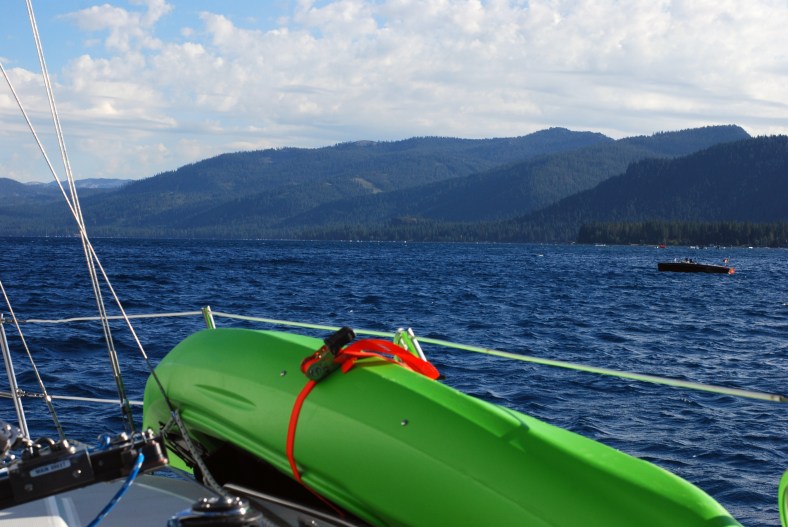
As our mooring ball came into view around 7:30 p.m., I finally began to relax, and realized just how tired I was from the long day of running from thunderstorms, recovering the dropped anchor at Skunk Harbor, fighting the big rollers along the lee shore around Sand Harbor, and pounding our way back home. I took a peek into the cabin and shook my head. You would’ve thought we had pitch-poled the boat in the great Southern Ocean, as our gear bags, food, seat cushions, pillows, towels and more sat a big heap in the middle of the cabin floor. I turned back to the cockpit and just felt the tiredness sink in.
“Jamie, do you think adventures are always hard?” I asked.
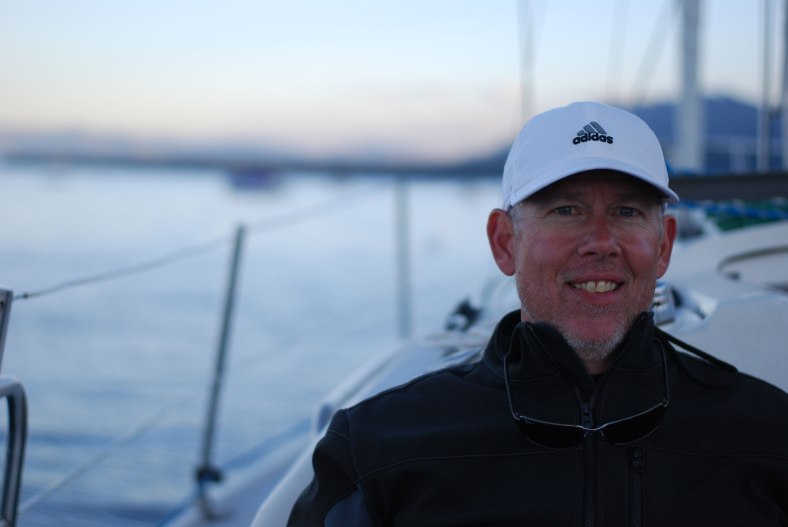
“Well, let me put it this way.” Jamie began. “You could travel the world and stay in five-star hotels every day, and you’d see a lot of sights, but it wouldn’t be an adventure. Having said that, there are probably a few things we could’ve done on the planning end that would’ve taken some of the guesswork out of this adventure … like going around by car or hiking down to Skunk and Sand Harbor to really check them out to see if they would be safe harbors in a storm.”
And even then, you really don’t know what it’s going to be like until you sail into them in whatever conditions are happening at the time, I thought. So ultimately, you’ve gotta take what comes your way and deal with it the best you can.
“Tell you what.” Jamie said. “Let’s not worry about cleaning up or anything until tomorrow. Tonight, I’ll cook us a great dinner; we’ll get a good night’s sleep, and we’ll take our time getting everything offloaded in the morning.
And that’s exactly what we did.
Fair winds and smooth sailing. —DB
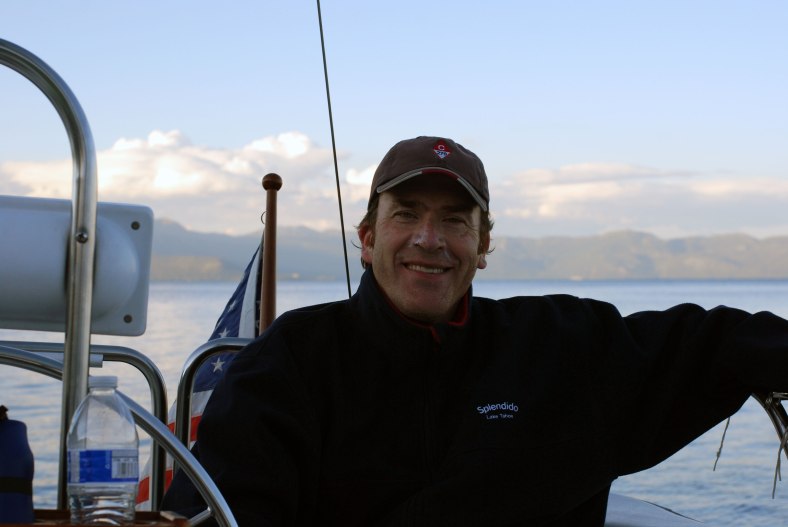














 Sailing Lake Tahoe on a good old boat