Sleeping aboard a sailboat on a calm summer night can be one of life’s simple pleasures. For me, that typically means setting out two hooks in a V-configuration, just to have that extra sense of security, and arranging sheets and halyards to minimize noise in the rigging. I flip on the masthead light and settle in, feeling the residual roll and heave you can expect when speedboats have been out on the lake all day. After an hour or so, these swells flatten out, and slumber is deep and satisfying. Until, that is, there’s a major bump in the night, and you bolt out of bed to see what’s going on.
(c) laketahoeG/The Dam Café @ Lake Tahoe, 2016.
That’s what happened last summer around Labor Day. Debbie and I were boat-camping along the west shore of Lake Tahoe when, at about 2 a.m., I felt a dramatic rise and then fall of the boat. About 8-10 seconds later, there was another. When you’re sleeping, this change really grabs your attention, because you have the sudden and somewhat unpleasant sensation of falling.
I rolled out of the aft berth and climbed up on deck. In the moonlight, I could see a set of widely spaced, two-foot swells coming our way out of the northeast. The distance between the crests seemed like about 20 or 30 yards. In my fogginess, I was wracking my brain to think what would cause these swells on this calm and windless night. I began to think that maybe there had been a localized earthquake that caused them, but a quick check of my mobile news feed shed no light on that theory.
After discussing the phenomenon with a very sleepy Debbie, I decided to bundle up with a blanket and sit on the lazarette for a while to watch and see if anything changed. For more than an hour, this line of swells kept coming, never varying in wave height or wavelength. Staring out across the water, I eventually relaxed a bit and decided to go back to bed, visions of tsunamis put to rest. But I was still curious, so the next day I did some research and discovered seiches, or standing waves peculiar to bounded bodies of water like Lake Tahoe.
I knew from listening to the news earlier that day that there were high winds predicted out over the Black Rock Desert – about 100 miles north of Lake Tahoe – as the Burning Man Festival was happening, and burners were advised to shelter from the blowing dust on the playa. Lake Tahoe is pretty big – about 22 miles long – but evidently the low pressure acted on the northeast end of Lake Tahoe and set up the standing wave known as a seiche. Here’s a beautiful video posted by The Dam Café of Tahoe City that captures the essence of Lake Tahoe’s seiches. Just knowing that the seiche phenomenon is a “thing” will help me rest a little easier.
My buddy Jamie and I spent a couple of days doing a complete rebuild of the heat exchanger on Splendido’s 1993 (British) Perkins Perama diesel engine. We were losing coolant; we thought the season was over; and we weren’t sure we could fix it because frankly, they don’t make some of the parts anymore. In the end, we got it fixed – and this is the celebratory sail.
The upshot of the whole heat exchanger exercise, I realize now (with chagrin) was that the heat exchanger unit wasn’t really broken at all. Three weeks of working on it and nearly a thousand dollars in parts later (don’t get me started on that account), I have come to the realization that this was a classic case of attribution error: Yes, the coolant level was going down every time we sailed, and yes, the hot water heater wasn’t heating water for the boat after a long session of motoring. But after tearing into the systems in the back of the boat over a period of three weeks, I discovered that 1) the hose connecting the engine to the hot water heater had come off, so no water was going into the hot water heater, resulting in (you guessed it) no hot water. Secondly, since I had the opportunity to become intimately familiar with the heat exchanger tank and element over the course of tearing it down three separate times, and getting a better understanding of the way the impeller forces water through it, it dawned on me that replacing the heat exchanger element didn’t improve the situation of the coolant dropping every time the engine was run. The thing just seems to lose water to the level of the lowest point of the heat exchanger element when the engine runs. Keeping a close eye on the thermostat, however, shows the engine staying right at 140 degrees, even on long motors of an hour or more. I’d be open to hearing from anyone who has experienced a similar situation with their Perkins Perama M20.
Fair winds and smooth sailing. DB
Update October 2022:Oh, FFS! The solution was staring me right in the face all along.
For those just tuning in, the backstory is this: When I first bought this sailboat, the guy I bought if from said, “Oh, by the way, you have to add a little water (a pint or more) to the radiator every time you start up the engine.” So, since October 2010, that’s what I did. Apart from being a pain in the behind, though, I alway had this nagging feeling that something wasn’t quite right about that. But it seemed to work, and I was intent on sailing, so the years rolled by.
But that nagging feeling never quite went away. So diving back into this fall, and after doing some research (actually reading the frickin’ Perkins M20 user’s manual thoroughly for once!) I thought the real problem with the missing coolant might have something to do with not having coolant in the reservoir underneath the galley sink (a related part of the solution, as it turns out), but there’s more to the story.
I also thought, after reading up and studying the “caps” on the end of the pipe stack, that the assembly might be missing O-rings on each end (are there supposed to be O-rings?, I thought), to better seal the caps to the tube stack. I was getting closer.
My new best friend and role model Ancil (the fellow sailor who lets me keep my boat in his pasture in the winters and a very mechanically inclined guy) came aboard as I was winterizing Splendido the other day, and I told him what I was up to, and then he said, “let me take a look at the engine.” I had already opened everything up, so I invited him into the cabin and he started examining the engine front and back.
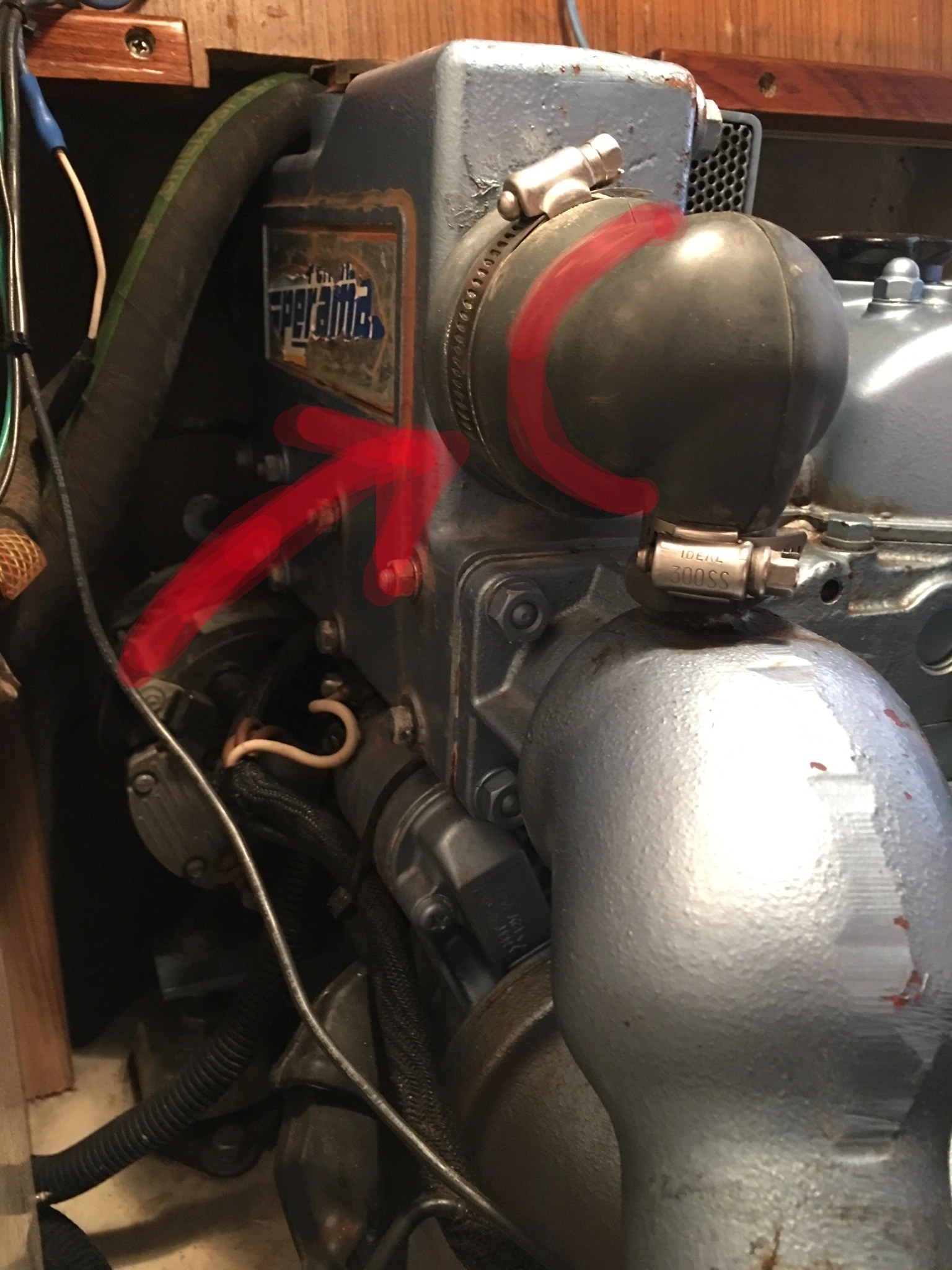
It Was Missing a $2 Hose Clamp on the Exhaust Side, Dagnabit!
At length, Ancil noticed something I hadn’t noticed in all the years I’ve owned the boat: the “cap” leading to the exhaust only had one (1) stainless-steel hose clamp instead of the requisite two (2) hose clamps — the missing hose clamp was the one that encircles the tube stack itself — so this oversight was allowing the cooling lake water and the radiator coolant water to blow right out the exhaust. (Fortunately, since we only sail four months in the summer, I have only been using tap water as coolant all these years because I didn’t want any antifreeze going in the lake. I just drained all the water out of the engine’s water course when winterizing every fall.)
Ancil tossed me a $2 hose clamp and suggested I get a wire brush (and maybe some steel wool) to brush away the corrosion on the male ends of the heat exchanger housing where the caps connect, and also using some dielectric grease applied to the rubber caps to help in sealing those to the heat exchanger. Then, tighten tighten tighten the hose clamps (all four, in this case) — especially the one exiting the tube stack, and that should fix things.
So, that’s what I did. Then, I topped off the tank with real 50/50 mix coolant (after gently hammering the rim where the radiator cap sits into perfect flatness, as it looked a little high on the front end), attached the fake-a-lake hose to the seawater intake thru-hull, and fired up the Perkins Perama diese engine. I let it run for about 30 minutes to get it up to temperature, then went full throttle for about 4-5 minutes on Ancil’s advice, to blow out the carbon that had built up in the engine. After shutting it down, I came back the next day and opened up the radiator cap, and voila: the coolant was filled right to the rim. For. The. First. Time. Since. I’ve. Owned. The. Boat.
Yes, folks, the Mystery of the Missing Coolant is finally — and somewhat embarassingly — solved.
The red semi-circle shows where there should have been a stainless steel hose clamp right over the exit of the tube stack for all these years.
Addendum: Filling the Undersink Coolant Reservoir
I should note that, before Ancil showed up, I filled up the coolant reservoir (no easy task — for starters, it’s incredibly hard to reach, as it sits on the aft wall underneath the galley sink, and it is quite high up. Access is through the cupboard door below the sink, so it took some serious contortions to get coolant into it. I started putting it in cup by cup, but then took a stab at slithering the 1-gallon jug throught the hoses and gently angling it toward the top opening. My back was beginning to ache, as was my core, so I grabbed the life sling bag and used that to cushion my backside. Ever so slowly, I was able to get the jug’s mouth over the reservoir opening and fill it about 2/3 of the way up. (Hint for next time: Use a sports bottle or get a shallow funnel to catch the spills.)
Happy to Take One For the Team A lot of folks wouldn’t even admit to making such a bone-headed mistake as this one with the missing hose clamp, but if it helps even one sailor out there fix a similar problem, then I’ll take the hit and be happy that someone else doesn’t have to go through the same hassle as we did. Occam’s razor, folks: The simplest solution to a problem is the most likely solution. Painful lesson learned.






 Sailing Lake Tahoe on a good old boat