

I don’t think my fellow sailors are scouring the internet to find out about heat exchangers on sailboat engines, but at the moment, I find myself dead in the water for the past three weeks because our trusty little Perkins Perama M20 diesel engine is under repair. Why, you ask? Well, because it was losing coolant at an increasing rate – a pint or more between sailing outings – and I couldn’t figure out the reason behind it.

Now, Debbie and I have owned Splendido since 2010, and it seems like she was always losing a bit of water level in the radiator since the very beginning. I attributed it to maybe a loose radiator cap or Tahoe’s high altitude (you never really notice yourself sweating here on warm days – our low humidity just seems to wick it out of you). But there was no sign of leaks on the outside of the engine, and no water in the bilge. It was a real head-scratcher, but I didn’t particularly worry about it until recently, when it seemed to be losing more and more coolant.
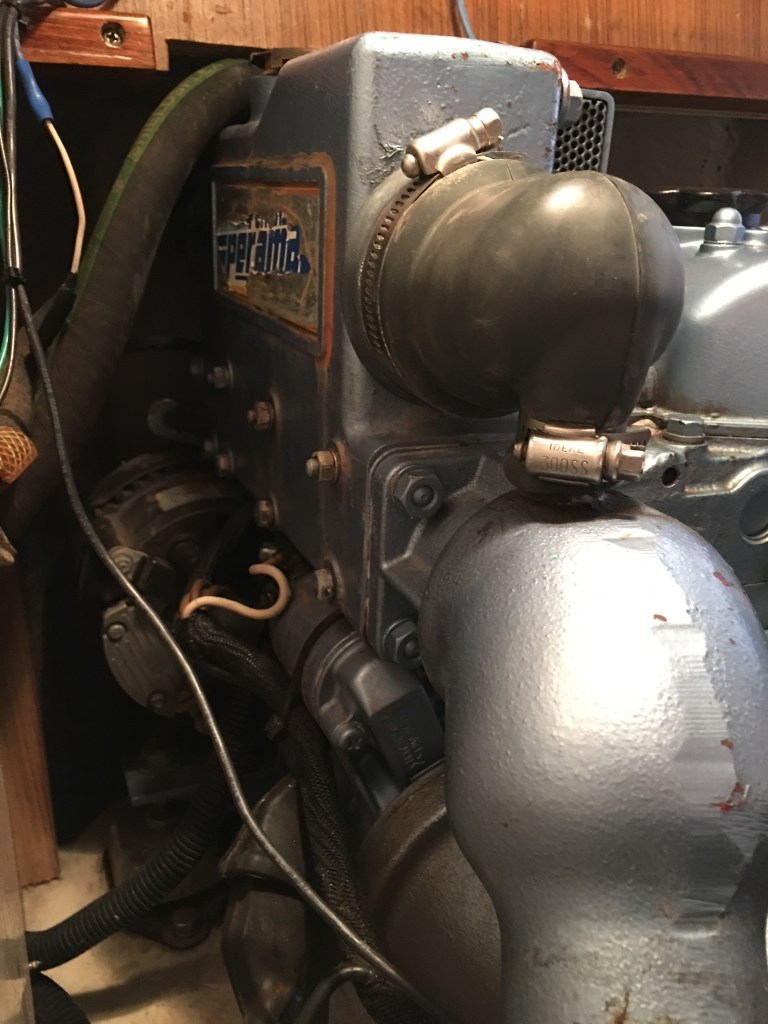
When I noticed that the coolant level seemed to be dropping to a larger extent between sails, I began to investigate the problem on the internet. After all, Google knows everything, right? 🙂 A couple of other sailors reported a similar situation, and what seemed to happening is that there might be an internal leak where coolant was being flushed out with the seawater exhaust.

After scouring the Perkins Perama M20 service manual, I decided to email my friends at Trans Atlantic Diesels and find out what I was getting myself into. They assured me that it was a very simple exchange of parts, and they would ship a replacement kit out right away. Thus emboldened, I went to the boat to see about extricating the failing heat exchanger. Now, the working area around the engine in our Catalina 270 is tight, to say the least. I have extra large hands, which makes things even more challenging. Finally, at my stage of life, I need to wear readers to see just about anything close-up, so tearing into an engine in dim light with these constraints had me losing a little coolant as well.

I removed the four bolts that attached the exhaust manifold and the eight bolts that held the heat exchanger onto the side of the engine. Gently tapping and cajoling the liberated unit enabled me to get it about an inch free of the engine, but something was holding it back. Feeling around in the dark, I detected a small hose at the base of the unit. I managed to get the hose clamp off of that – and still no further movement. I didn’t have one of those mirrors-on-a-stick on board, so I decided to remove the alternator to get better visibility into the problem. Once the alternator was off (which took some doing), I could see that it was the housing of the starter that was impeding the heat exchanger from coming completely off. The starter motor is held by two fasters – one of which is a 13 or 14mm bolt. The other fastener, at least on this model, required an 8mm allen wrench – which I didn’t have on board. It was getting late in the day, so I cleaned up everything and drove back to Reno (43 miles) and picked up a full set of metric allen wrenches. (Note: I suspect this is the only fastener on the entire boat that requires an allen wrench.)

The next day I drove back to take another crack at the starter motor, and voila! – the heat exchanger came off as easy as kiss my hand (to paraphrase Captain Jack Aubrey of Master and Commander fame). As luck would have it, though, I then realized that Trans Atlantic had sent me the heat exchanger kit for the Perkins M30, which is a larger engine for a larger sailboat. (A friend later joked that I should’ve called them up and asked for the rest of the sailboat that comes with the M30 engine, as a way of making up for the shipping error. 🙂
Alas, first-world problems. I reconciled myself a long time ago that all this stuff is just part of sailing, and that the joy you get from sailing is only enhanced by the effort it takes to get out there. If it was easy, anybody could do it, right? 🙂
I texted Sheri at Trans Atlantic to get the exchange of parts set in motion, and then dove into 68º F. Lake Tahoe and swam around the buoy field for about a half-hour before I packed up and headed home. Whether it all comes together before summer is over will be the next chapter in this odyssey. Stay tuned!
Fair winds and smooth sailing. DB
 Sailing Lake Tahoe on a good old boat