

As a sailor and as a human being, I’m concerned that the world is warming and that climate and weather patterns are changing because of that warming. There; I’ve said it. Now, I’m as guilty as anyone of not always thinking about my own carbon footprint, but one of the reasons I’ve always been drawn to sailing is because of its relatively small (when practiced conscientiously) carbon footprint.

The recent smoke from the devastating California wildfires has got me thinking about climate change, and about our role in it, and what we can do to fix it. People have lost their lives, homes, property, kin, livestock, livelihoods, and pets from the wildfires. All I’ve lost is a few weeks of sailing at what is traditionally a postcard-perfect sailing site, Lake Tahoe. But the relentless march of carbon accumulation in the atmosphere and the ever-increasing high temperatures worldwide signal that it’s high time to act.

One thing I’ve noticed over the 32 years I’ve lived here is that the water is warmer in summer at Lake Tahoe. Just two weekends ago, I was swimming in 71-degree water off of D.L. Bliss State Park. Seventy-one degrees F. Compared to 1986 when I was hypothermic after a dip in late August, today’s temperatures seem downright balmy.
I work for a major research university, and many of the scientists there that I’ve spoken to are worried. More than one has told me that climate change is real, it’s here, and its effects are outpacing even the predictions in the movie An Inconvenient Truth. One scientist told me that what’s concerning to him is that we have no models to predict what Earth’s weather will be like if our planet had ice-free poles. Think about that for a moment.
Lake Tahoe is warming at an alarming rate. In July of 2017, the average lake temperature for that month reached an all-time high of 68.4 degrees F. – a full six degrees warmer than the July 2016 average. This data is from U.C. Davis scientist Dr. Geoffrey Schladow’s work at the Tahoe Environmental Research Center.
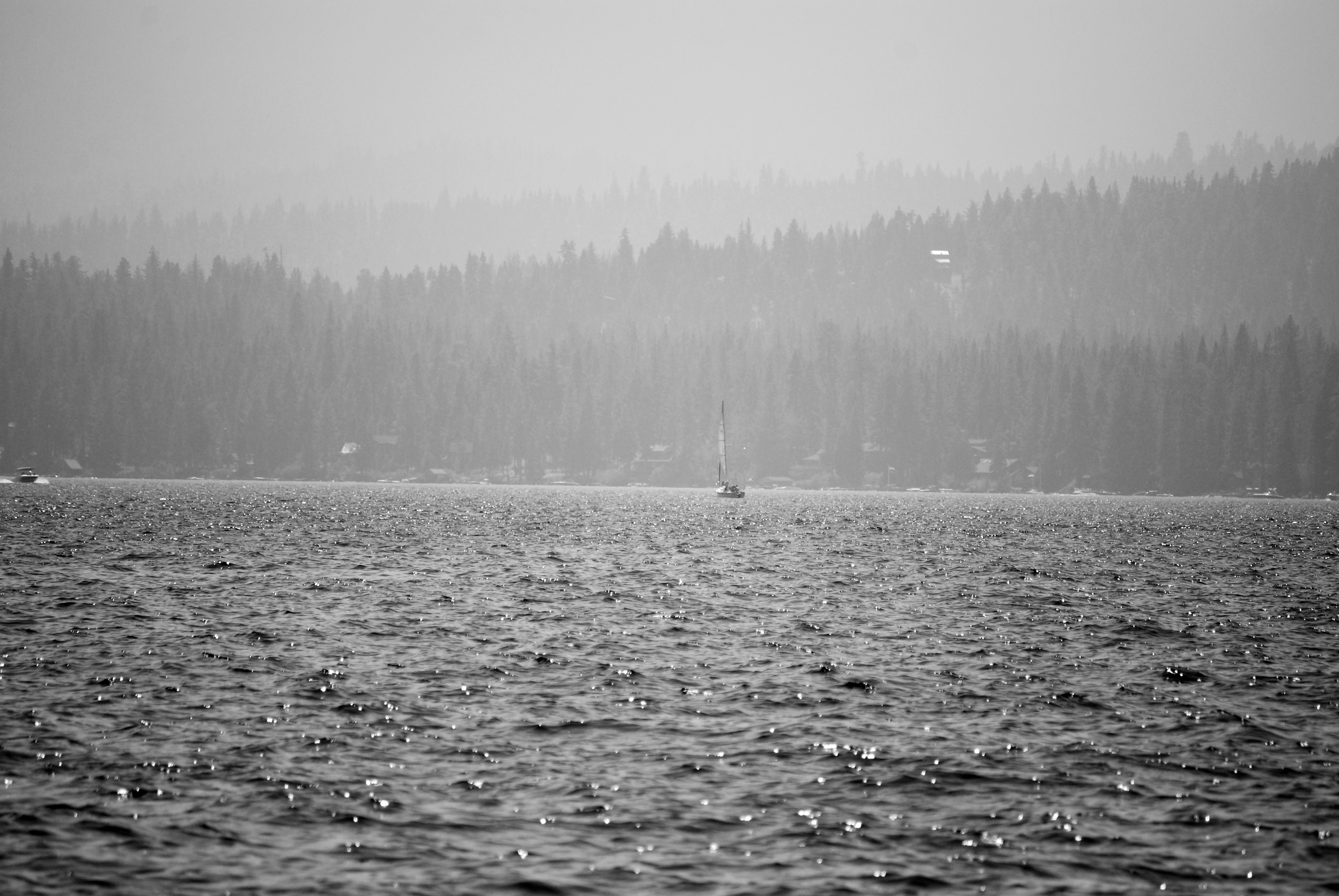
California’s wildfires are more explosive this year because of the drying effect warmer temperatures have had on forest and grassland fuels. That sucks for the people whose lives, homes, and property are endangered; it sucks for the massive state and federal resources (read: money) required to fight fires; and it sucks for sailors and citizens who enjoy the great outdoors or even their own back yards. Heaven help the folks who live on coral atolls, or low-lying coastal areas, like the islands in the Chesapeake Bay.
Bloomberg and NASA’s Goddard Institute for Space Studies have done an amazing job with infographics that chart the rise of greenhouses gases and the corresponding rise in global temperatures. They also look at other possible factors. In the end, it’s the carbon and methane. And it’s pretty sobering.
So, what’s a sailor or a citizen to do? There are a few things we can do: reduce our fossil fuel use. Switch to solar or wind power. Consider eating less meat. Add to the insulation in our homes. And urge our representatives to join the Kyoto Protocol and enact policies that hasten our transition to renewables. Once installed, solar and wind power plants can produce low-carbon energy for decades. As these technologies scale up, prices are converging to the point that solar and wind power is becoming cheaper than fossil fuels, and battery technologies like those produced by Tesla are helping to mitigate the storage problem.
There’s warming and smoke everywhere. It’s clearly time for the U.S. – and for each of us, individually – to lead by example, and work to put out the fire.
Fair winds and smooth sailing. DB
 Sailing Lake Tahoe on a good old boat