

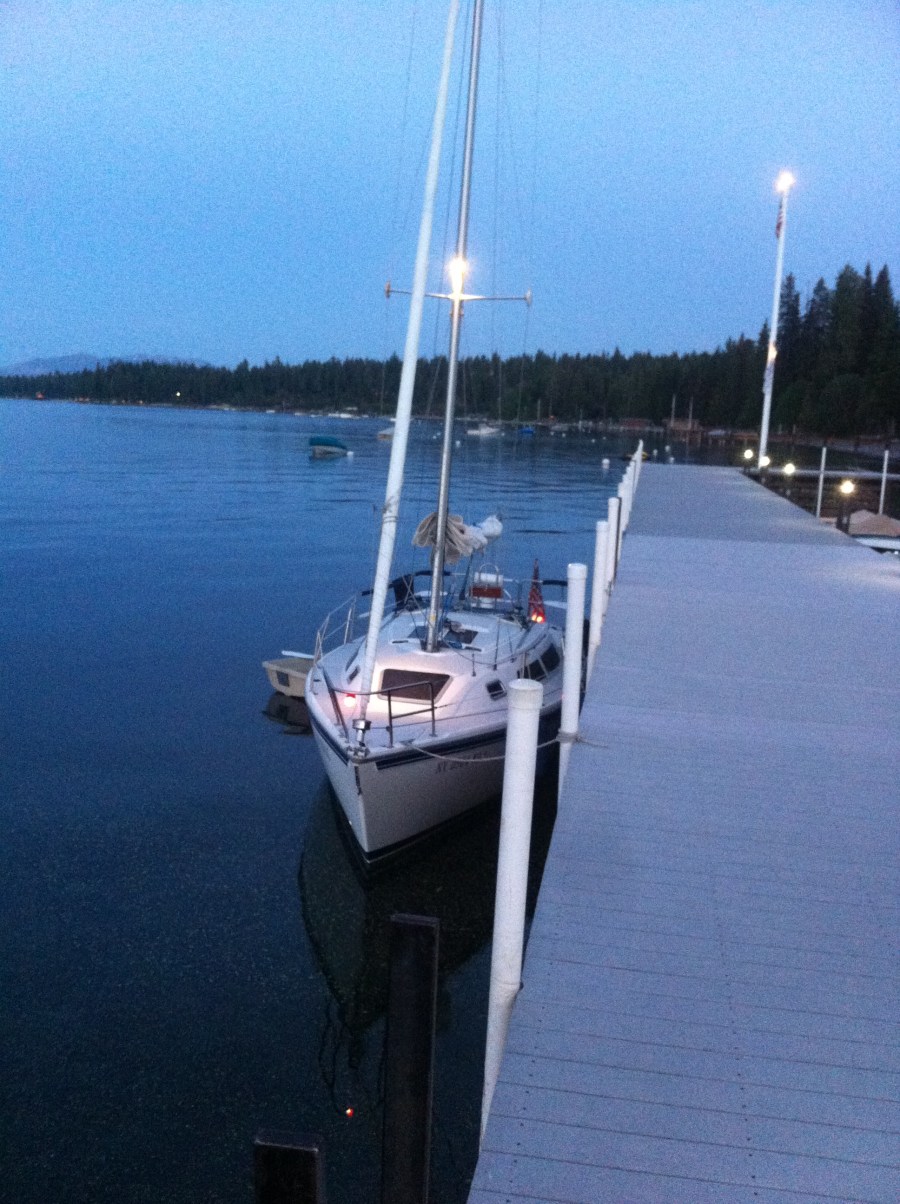
Lots of great sailing on Tahoe this year, and more on that in future posts, but I want to take a moment to talk about polishing the fuel system on a 1993 Catalina 270. As I’ve chronicled before in other posts, I have had more than one “fuel starvation/I think it’s the filters clogging up” incident aboard Splendido. On July 2nd, I went out for a singlehanded sail, and since there was no wind, I ended up motoring out in the direction of Sugar Pine Point.
About 1/2 mile off the point — and about two miles from Obexer’s marina — the engine started to weaken and then just died. I drifted for a bit and re-started it, and was able to sort of poodle it back to Obexer’s, where it once again died, just close enough to coast into the guest dock.
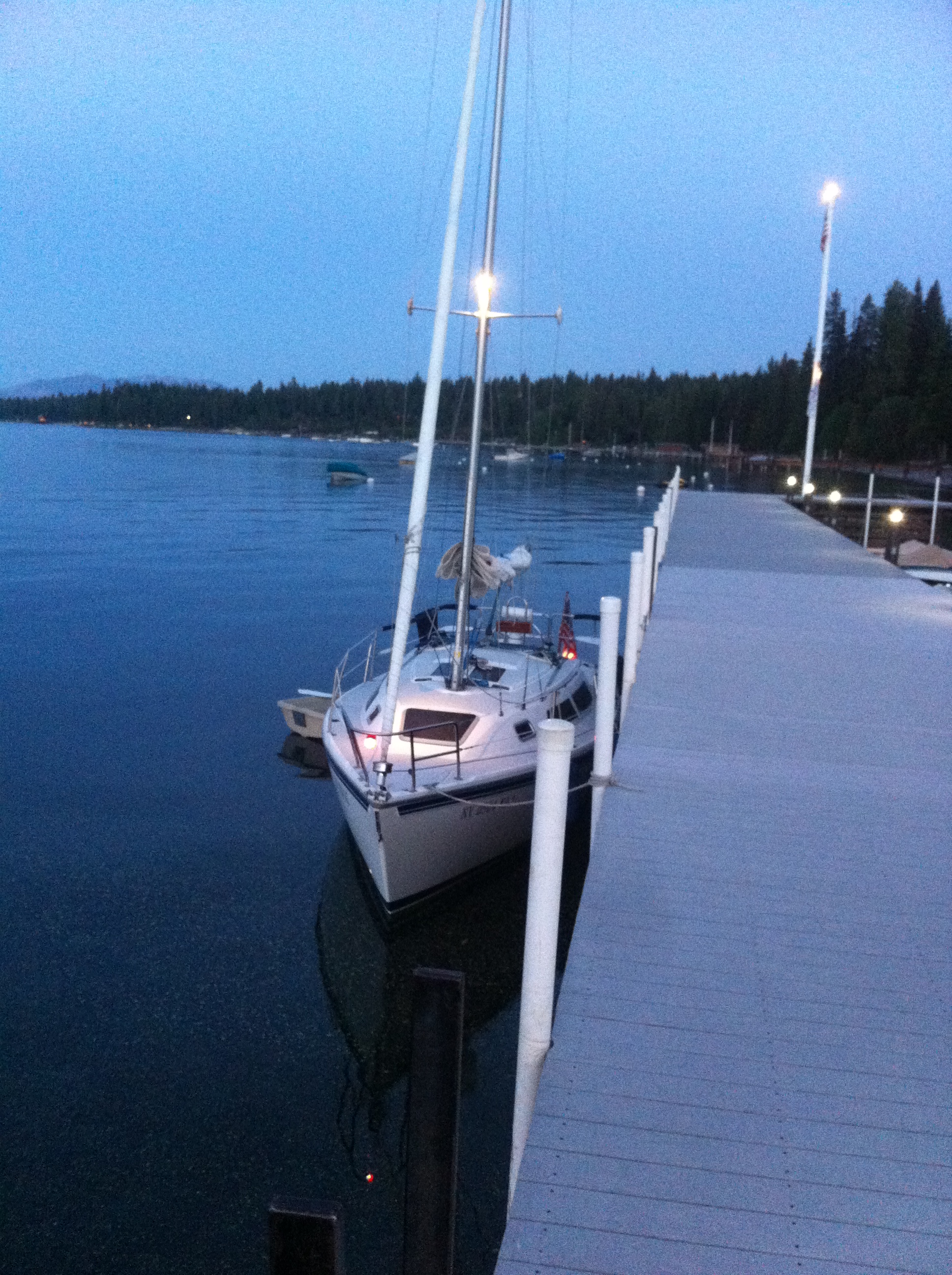
Thinking it was clogged filters, I tied up and proceeded to change the secondary filter, as that was all I had on the boat, having just changed the primary filter in May. I was not happy, as you can see from this dockside selfie.

Luckily, my friend John Turner of the new Grand Cru was just wrapping up for the night, and he came by to help. Long story short, we couldn’t get her started, so he did a workaround that bypassed the primary fuel filter but not the secondary, and it fired right up. The workaround was made using the “straw” from a handsoap dispenser and a fair amount of electrician’s tape. Anyway, I needed to get back to our mooring ball about 1.5 miles to the north, so I set out under a darkening sky and hoped that our workaround would actually work. (It did.)

The challenge, of course, was motoring up the West Shore of Tahoe at night, hoping the engine wouldn’t quit, and planning what to do if it did.

All my anxiety was for nought; with the compass and GPS on my cell phone, I was able to cruise up the coastline and snagged the mooring ball on the first try. I rowed the dinghy back to shore, plotting a “permanent” fix for this irritating problem.
To back up a bit, I realized in April that I had forgotten to top off the diesel tank over the winter, as this prevents condensation from forming in the tank, which then sinks beneath the diesel fuel. In this fuel/water interface, microscopic fungi, yeast, and bacteria — up to 27 different kinds of bacteria, in fact — can grow, creating organic matter and sludge that clogs fuel filters. So, when the engine started making sounds of fuel starvation, I naturally thought that this is what happened.
So, I pulled out my September/October 2012 issue of Good Old Boat magazine, as I remembered an article by David Lynn that showed how to make a simple fuel-polishing system from a good filter, a simple fuel pump, some wire leads, hose, a switch, and a wand to stick in the tank. With a lot of generous assistance from my friend Michael Salley, the final product looked like this:
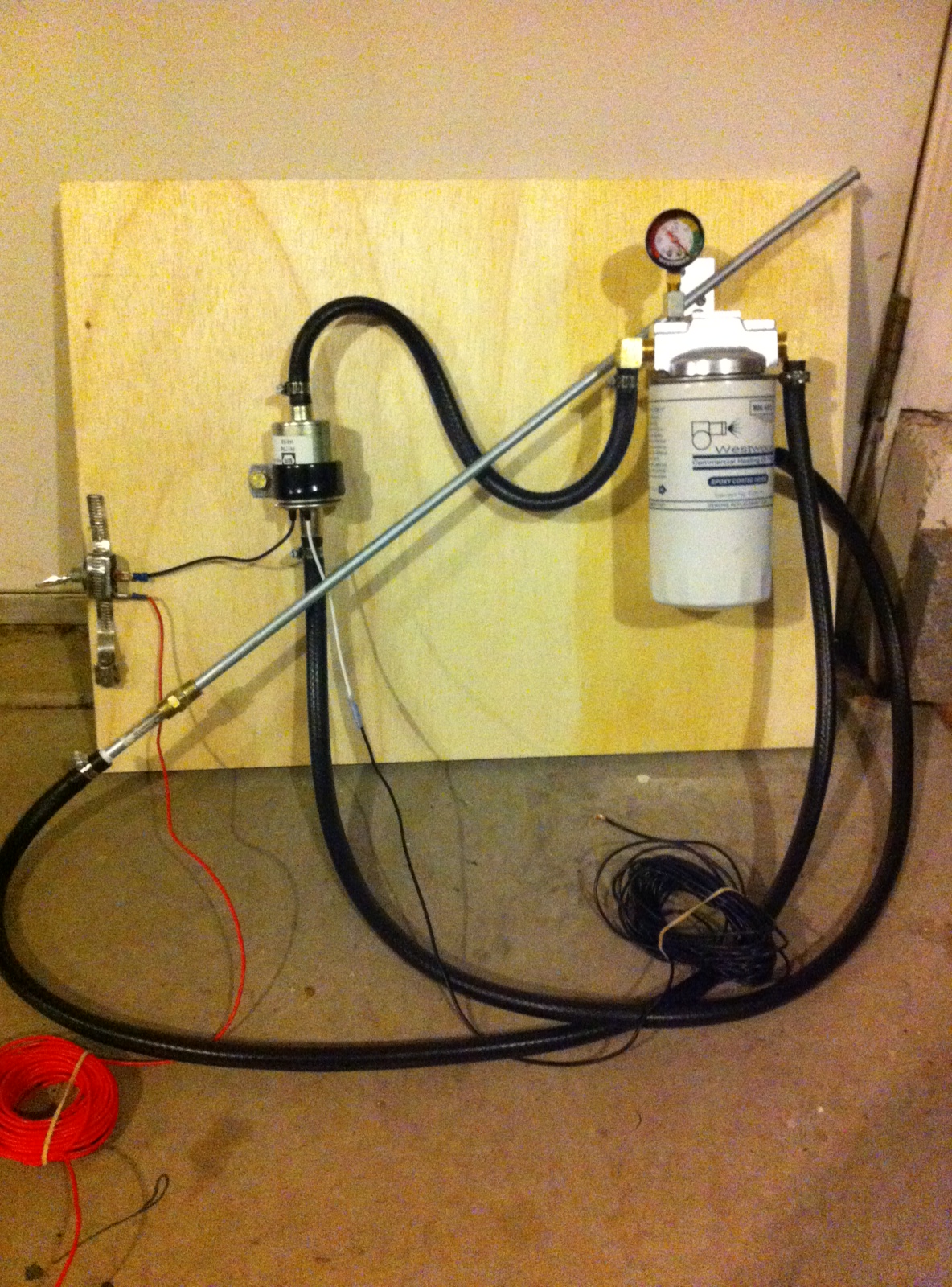
Oddly, I decided to go up early on July 4th, hoping to polish the fuel and get everything running like a top so Debbie could come up and join me on the boat and we would watch fireworks together that night. Or, as Debbie likes to say, “from your mouth to God’s ear.” I fired up the fuel polisher and hooked it up to the end of the gravity-fed fuel line that goes into the primary fuel filter. It took nearly three hours to process the first gallon of fuel, which I hoped to decant into three 5-gallon buckets (the ’93 Catalina 270 has a 14-gallon fuel tank). It was taking so long, I thought something else must be going on.
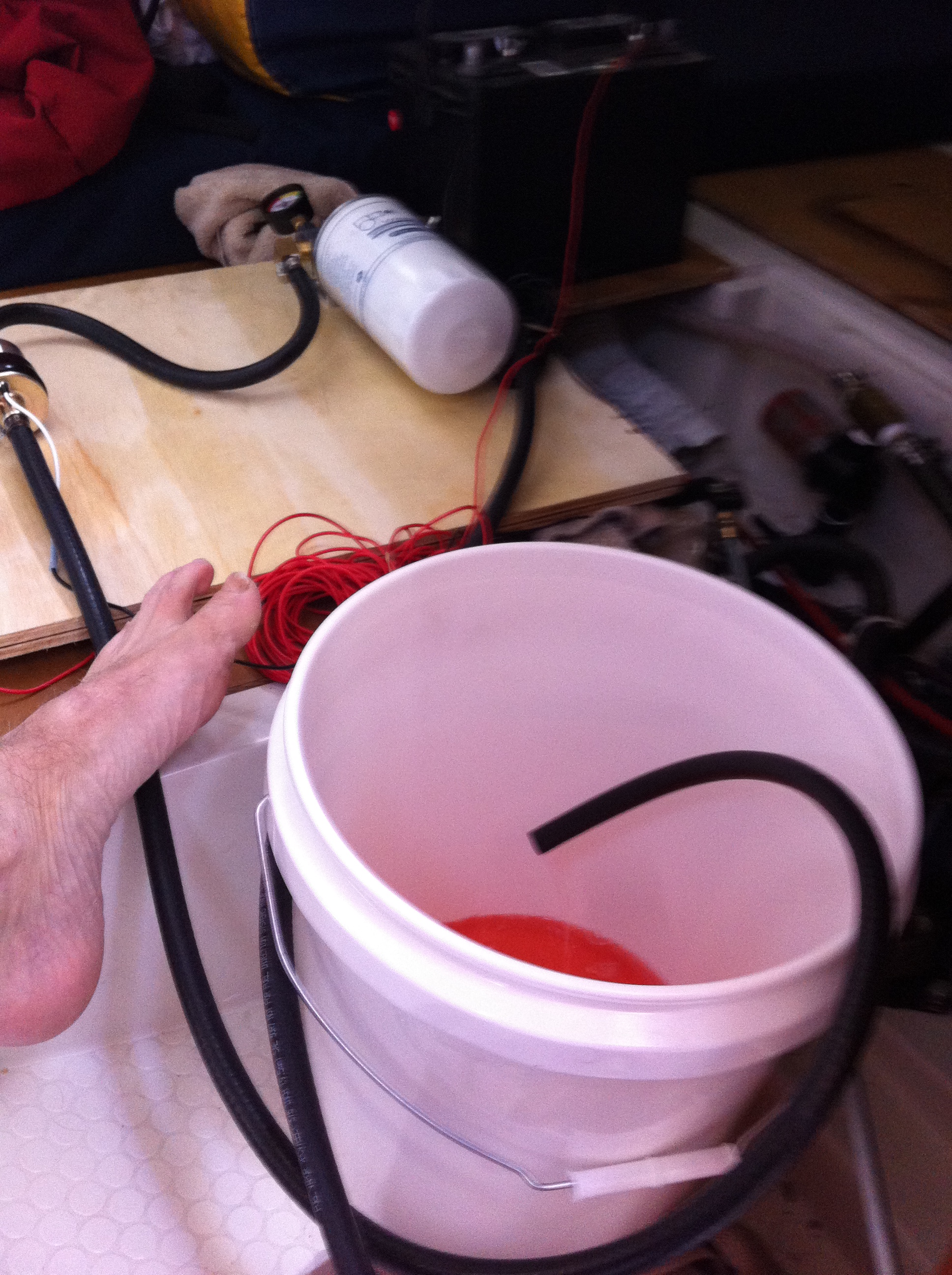
I opened up as much access as I could to the fuel tank, only to find that there are no large circular plates to unscrew so you can get inside the tank and wipe out the sludge that’s left over (like it showed in the magazine article); in fact, there was only a couple of places you could reach with tools, so I attacked the fuel outlet fitting. With a couple of turns of a wrench, I was able to pull out a 9-inch “straw” or “wand” that went down into the tank through about a quarter-sized hole. I unscrewed the wand from the fitting, and, on a hunch, blew through it. Hardly any air went through it. It was packed full of something. Wiping it down with a rag, I unscrewed the wand from the 90-degree fitting, and lo and behold, there was a bunch of degraded black webby filter material that had gotten sucked up into the wand and stuck in the 90-degree angle. I cleaned it out thoroughly, reassembled everything, and went back to the fuel polisher. Sure enough, the polisher began pumping out five gallons every 20 minutes or so, and in no time, I had drained and polished the entire tank. I decanted the sparkling-clean fuel back into the tank, bled the lines, and she fired up within 15 seconds. By this time, I was slightly overcome by fumes and the rock-and-rolling of the boat, because everybody and their mother was out on Tahoe for the Fourth, zipping around within 100 yards of the bouy field and creating quite a chop. Nevertheless, I was happy and relieved, and I let the engine run for a while to charge the batteries while I cleaned up the mess. I called Debbie with the good news, and we decided to bail on watching fireworks from the boat, as by that time it was late afternoon, and I was ready to be done.
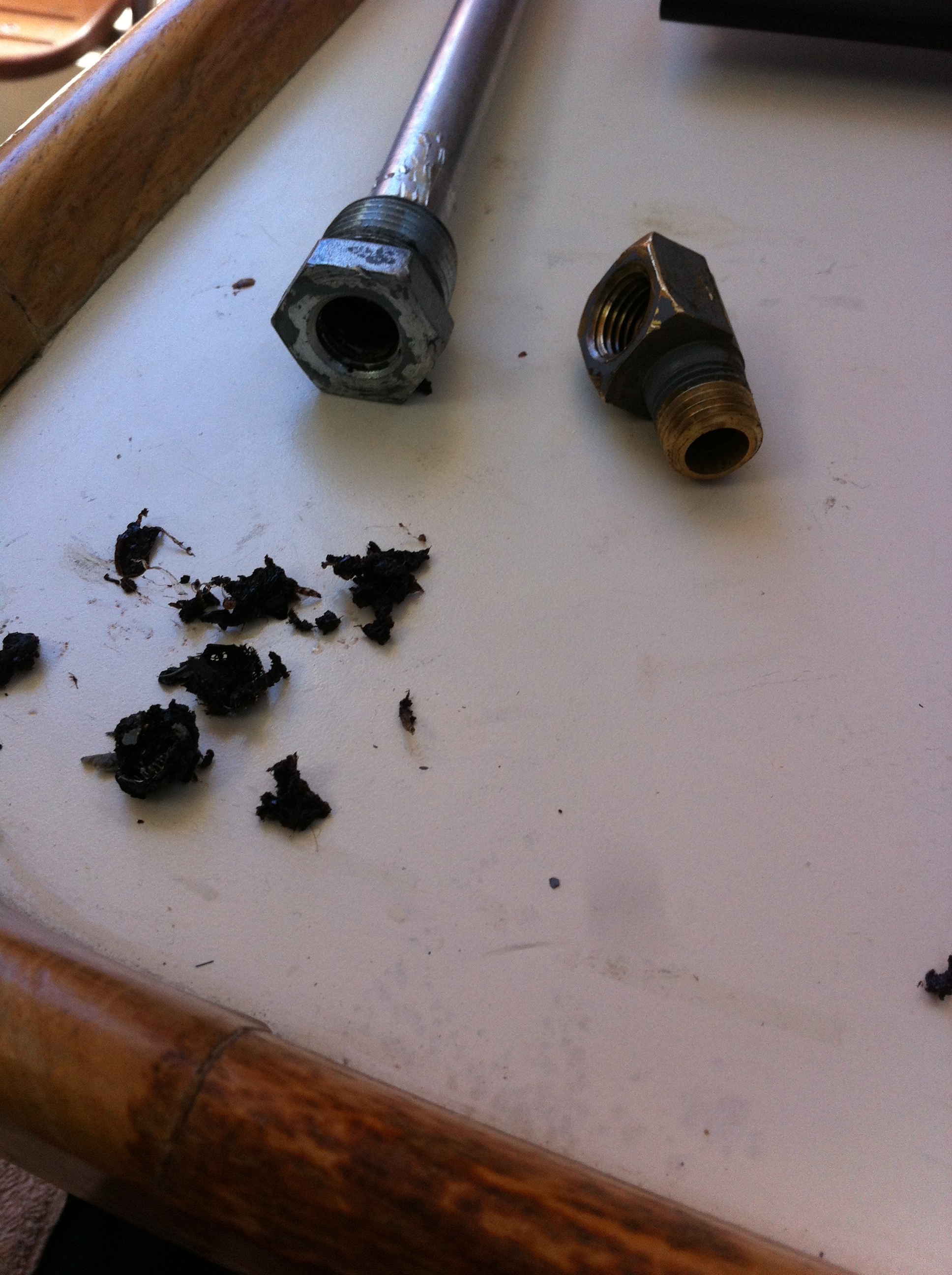
Since polishing the entire tank, our little blue Perkins Perama has fired up quickly every time, and has just run like a top. I can’t tell you how confidence-inspiring it is to know the fuel is pristine, and also to know a little bit more about how to work on diesels in general. The fuel polisher cost around $160, but I can use it over and over again, or lend it to fellow sailors in need of a polish. I have read about some sailors paying $1000 to have their tanks polished; bottom line, a visit to Napa Auto Parts and a little monkey-wrenching can save a sailor a bundle.
Fair winds and smooth sailing. DB
 Sailing Lake Tahoe on a good old boat